
It can be hard running a small business. If you want to sell to a large organisation like the UK Government, there are forms to fill in, checks to comply with, tenders to bid on, and a hundred other things. Luckily, there's the RM6237 Low Value Purchase System to make everything better. If a department wants to buy something below a certain threshold, they can contact any of the registered…
Continue reading →
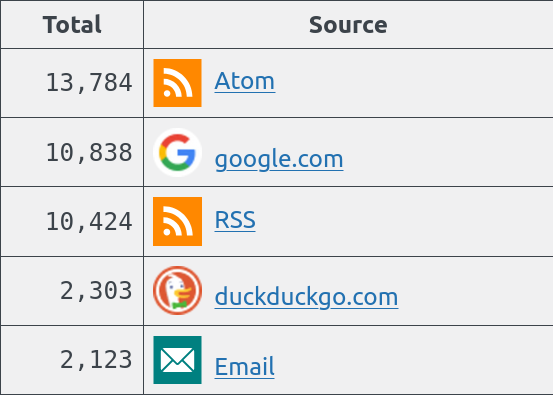
Yeah yeah, I know, data-point of 1. I recently read Susam's blog post where they said that "most of the traffic to my personal website still comes from web feeds" - I wondered if that was true for my site. I've been writing this blog for a while. I've never much bothered with "aggressive" SEO - I have a fairly semantic layout, all my reviews have metadata, and stuff like that - but I'm not…
Continue reading →

I dropped into a pub in central London and ordered two pints of draught beer. Obviously the price of everything is nuts these days - and doubly so in London - so I only winced a little bit when the cost came to about twelve quid. Shocking, obviously. But as we supped on our pints and discussed the state of the world, I tried to remember how expensive it was to have a pint when I was a lad young…
Continue reading →

How can you measure the popularity of a social network site? Perhaps by counting the number of active accounts, or the quality of the discourse, or even how many people reply to your witty memes. Me? I prefer to look at how many people visit my blog from each site. It is an imperfect measure - and a vain one - but lets me know where I should be spending my time. No point posting on a network…
Continue reading →

I read this brilliant blog post by Wouter Groeneveld looking at how many dead links there were on his blog. I thought I'd try something similar. What is a broken link? Every day, I look at the On This Day page of my blog and look at that day's historic posts. I click on every link to see if it is still working. If it isn't, I have a few options. If the site is working, but the content has…
Continue reading →
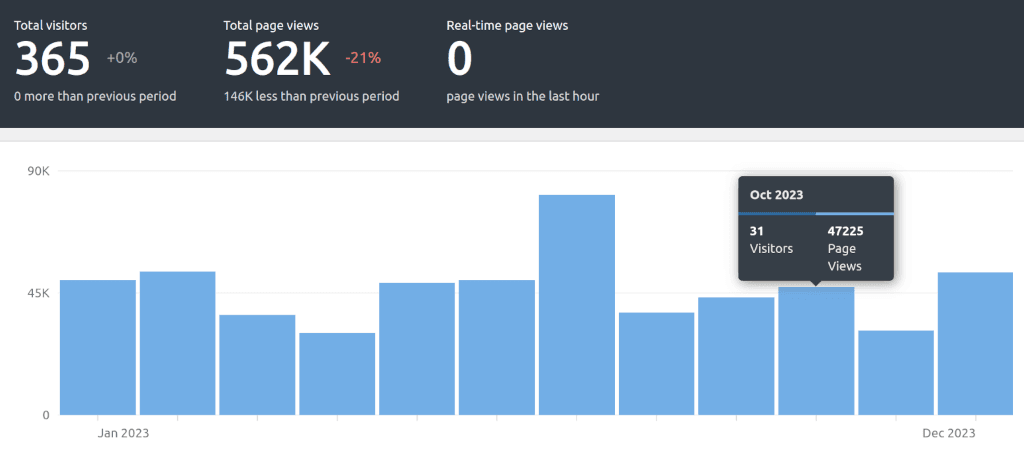
I've quit JetPack stats. I've moved to Koko Analytics. All the stats code is self hosted, it is privacy preserving, and the codebase is small and simple. But I am vain. I want all my old JetPack stats to appear in Koko so I can look back on the glory days of blogging. Koko has two main tables. The first is a summary table called wpbp_koko_analytics_site_stats : date visitors …
Continue reading →

It's sometimes useful to run experiments yourself, isn't it? New investors are often told that, when investing for the long term rather than chasing individual stocks, it is better to be invested for the longest possible time rather than trying to do "dollar cost averaging". DCA is the process of spreading out over time the purchasing of your investments. That way, you don't lose it all if the…
Continue reading →

August is meant to be full of gloriously hot days. An endless parade of sunshine and drinks in the park. This year it seemed mostly grey, miserable, and prone to pissing it down at a moment's notice. We all know that solar panels' efficiency wilts in the heat, but do they get a tan work standing in the English rain? At the beginning of August we installed a 4.8kWh solar battery to supplement…
Continue reading →

Much hullabaloo out of America. Apparently elite universities can no long engage in "Affirmative Action". How can they now admit a balanced and fair selection of the population? My suggestion is, as always, sortition. Let me explain. Most top flight universities around the world have the same problem. They have space for 100 students on a specific course. 15,000 apply. How do they select the…
Continue reading →

During my (brief) stint teaching senior leaders about AI, there was one question that I urged them to learn above all others. What is the acceptable failure rate? For this, I had to teach them two concepts. False Positives. For example, telling someone they have cancer when they don't. False Negatives. For example, telling someone they don't have cancer when they do. There is a cost…
Continue reading →

Truly, men have the worse of everything…⸮ But, there's something we blokes can be grateful for. No matter what grief the world throws at us, it'll always be the women's fault that there aren't enough babies! The other day, I saw this headline: The Business Insider article - in the "Economy" section - focussed solely on the lady-folk. Why do those pesky dames refuse to procreate? About hal…
Continue reading →
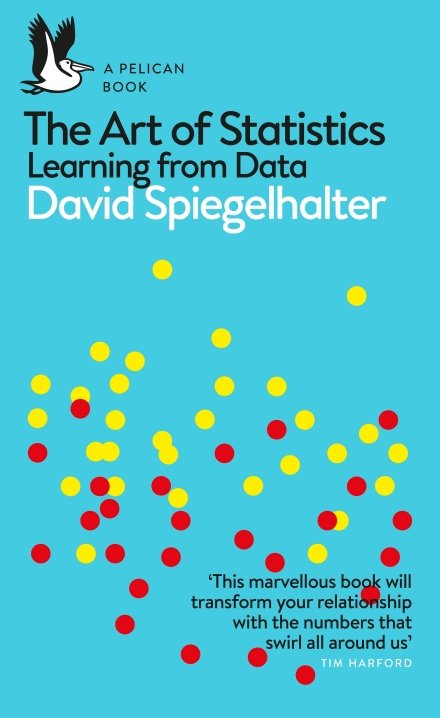
Do busier hospitals have higher survival rates? How many trees are there on the planet? Why do old men have big ears? David Spiegelhalter reveals the answers to these and many other questions - questions that can only be addressed using statistical science. Statistics has played a leading role in our scientific understanding of the world for centuries, yet we are all familiar with the way…
Continue reading →