I use Auth0 to provide social logins for the OpenBenches website. I don't want to deal with creating user accounts, managing passwords, or anything like that, so Auth0 is perfect for my needs. There are a wide range of social media logins provided by Auth0 - including the usual suspects like Facebook, Twitter, WordPress, Discord, etc. Sadly, there's no support for Mastodon. All is not lost…
Continue reading →

At the recent "Protocols for Publishers" event, a group of us were talking about news paywalls, social media promotion, and the embarrassment of having to ask for money. What if, we said, you could tip a journalist directly on social media? Or reward your favourite creator without leaving the platform? Or just say thanks by buying someone a pint? Here's a trivial mock-up: Of course, this…
Continue reading →

I'm neither a journalist nor a professional fact checker but, the thing is, it's has never been easier to check basic facts. Yeah, sure, there's a world of misinformation out there, but it doesn't take much effort to determine if something is likely to be true. There are brilliant tools like reverse Image Search which give you a good indicator of when an image first appeared on the web, and…
Continue reading →

Both Mastodon and BlueSky have the concept of "self-verification". Rather than trust a central authority to assess your notability and then bless your account (as Twitter used to do), they let anyone self-attest using Domain Verification. What does that mean? You tell the service what your website is. The service gives you a secret code. You upload that secret code onto your website. The…
Continue reading →

What does it mean to block someone on a social media site? Way back in the mists of time, we dealt with trolls on Usenet with the almighty PLONK - PLaced On Newsgroup Killfile. It meant your newsreader never downloaded their posts. They could rant at you all day long, and you'd never hear from them. It's what we would nowadays call "Mute". But, whether you're on Usenet or a modern social…
Continue reading →

It is sometimes useful to embed the contents from one website into another. For example, you may wish to quote a post from a microblogging site like Twitter, Threads, BlueSky, or Mastodon. All of them offer an "embed" button which will copy a snippet of code for you to paste into your website. Here's how they compare: BSky In my considered opinion, BlueSky is the only modern service which…
Continue reading →
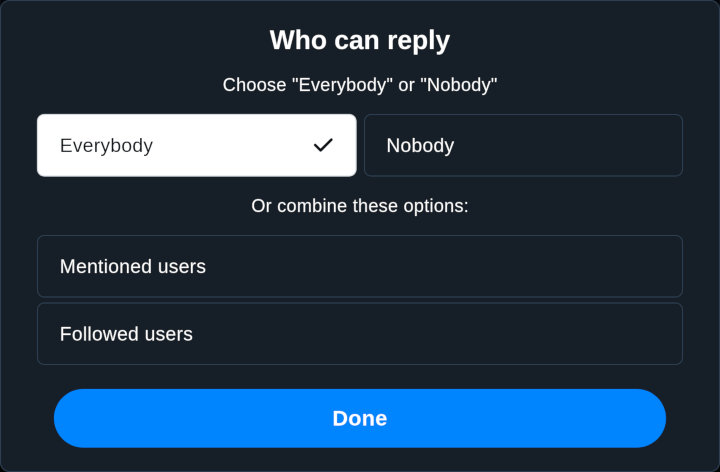
Vague thoughts as they enter my brainbox. The BlueSky social network has introduced "Reply Gating" - it looks like this: You can write your hot take on Taylor Swift and not be inundated by weirdos replying to you. Nifty! This is nothing new. Twitter has it. Facebook has the concept of "audiences" to restrict who your post is visible to. And, of course, blogging has this! There is a comment …
Continue reading →

One of the reasons I'm still on the original Mastodon.social instance is that I am vain. I joined shortly after the project was announced and, as a consequence, I have a "joined" date of 2016 and a user ID of under 10,000. This doesn't make me an "elder statesman" and is rarely useful beyond bragging rights. If I moved to a different server, my "birthday" would be irrevocably lost 😢 But… what i…
Continue reading →

The inimitable Simon Willison has a brilliant presentation all about managing side projects: It is all good advice. But I gently disagree with the slide which says: Avoid side projects with user accounts If it has user accounts it’s not a side-project, it’s an unpaid job I get the sentiment. Storing passwords securely is hard. Dealing with users changing their names is hard. Updating avatars …
Continue reading →
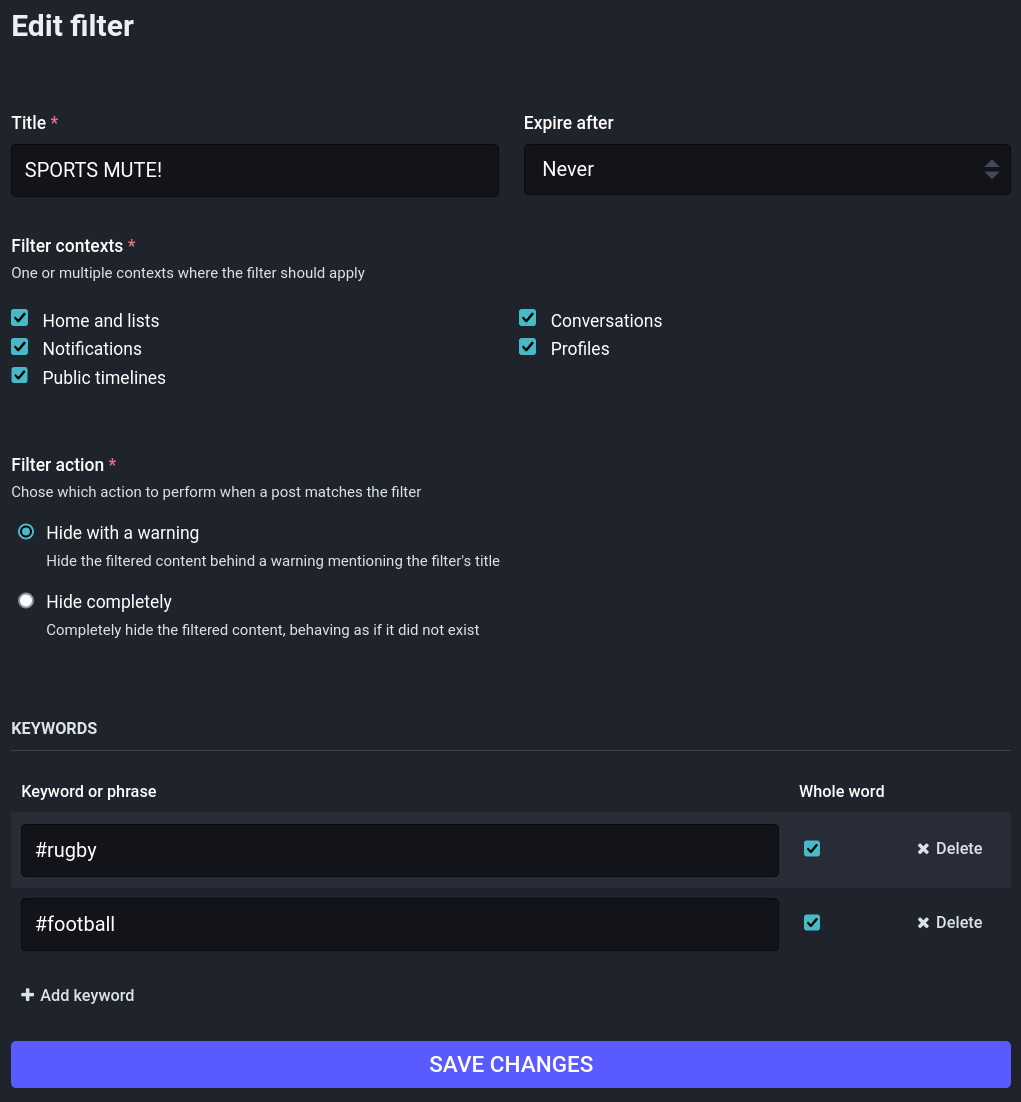
I do not care for the game of Rugby. After many wet and cold days on the school sports field, I had any latent enthusiasm for it beaten out of me. There is nothing you or anyone else can say which will convince me to take an interest in it. You may feel the same way about a specific sport, or the Great British Bake Off, or Linux. That's fine. We're all different. This can be a problem on…
Continue reading →

About a million years ago, I was discussing the FOAF (Friend of a Friend) ontology with its early proponents. It allowed you to define a machine-readable semantic relationship like "Alice is married to Bill" and "Bill is Carol's child" and "Carol works for David". That sort of thing. At the time, all the FOAF relationships were defined in terms of positive sentiment. There wasn't (and still…
Continue reading →

If you hang around on a social network long enough, you'll find the same tropes being repeated again and again. So, I thought I'd document some of the ones that I personally find annoying. This blog post is an extension of my moderately popular Twitter thread - with a bit more detail about why they are irritating. The Thief of Words .social-embed{all:unset;display:block;}.social-embed *…
Continue reading →