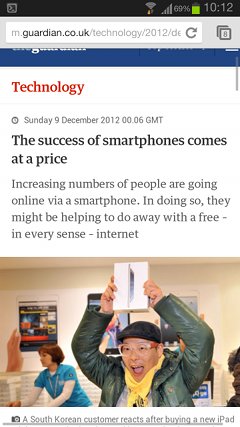
I usually admire The Guardian's technology coverage (not least because they occasionally feature me!) but their latest article - The success of smartphones comes at a price - is ridiculously bad. It posits three arguments. More people are using smartphones to access the Internet than ever before. Smartphones are heavily locked down. Mobile Operators are "corporate control-freaks". …
Continue reading →

One of Android's great strengths is its openness. The source code is (mostly) there for anyone to see. If you're a hardware manufacturer, you can use Android on your devices with just a few mouse clicks. But there's a problem in Android-land, one which has been growing for several years. Open Software has many advantages - one is the maxim "Many eyes make all bugs shallow". If you have…
Continue reading →

As part of the Parliament and Internet Conference, there was a panel discussion about 4G networks. These are my notes on the session. I've applied the Chatham House Rule - mostly because I can't remember who said what, rather than any backroom skulduggery. Any errors are mine and mine alone. Neither Vodafone nor EE have signed up to the Network Neutrality pledge. O2 have. (Disclaimer, I work …
Continue reading →

Facebook has been getting a lot of criticism for its lack of mobile revenue. A fact it tried to hide from its IPO. Much ink has been spilled, but is it really necessary for Facebook to worry? Here's a quick case study. Facebook has, in its infinite wisdom, decided that I would be interested in adverts for cancer. Or, perhaps, AXA have decided that 30 something males are a prime market. The …
Continue reading →
(The author currently works for Telefonica - but these views are his own) Do you remember when mobile phones were in their infancy? The frequencies allocated to Racal's Vodafone and to BT's Cellnet were mutually incompatible. You couldn't simply switch your SIM to another handset, you had to specifically make sure that it supported your carrier's frequencies. As the mobile market matured, "dual …
Continue reading →

So, a year after throwing the baby out with the bathwater by dumping its Palm WebOS software, HP has decided it wants to get back into the smartphone game. HP's position isn't quite as perilous as Nokia's "Burning Platform" was, but there are definite similarities. Apple sells more iPads than HP sells PCs, their traditional market for printers is drying up, its share price is on the wane, and a …
Continue reading →
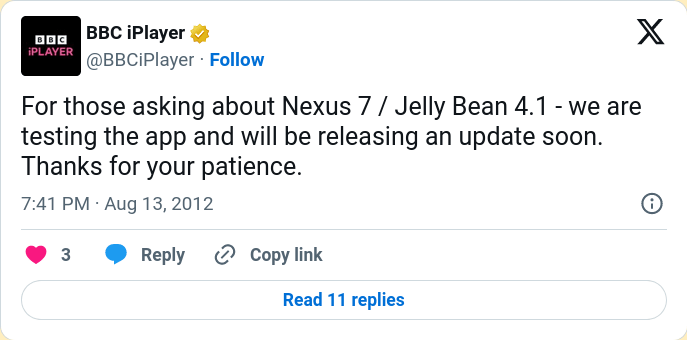
Two years ago, a bunch of smart people told the BBC that its plans to build iPlayer for Android on Adobe Flash was nuts. We argued loudly, passionately, deployed logic and reason, and provided specific technical details. Naturally, we were ignored. Sure, Flash was only on a few high end devices now, but the BBC were confident that Flash would be soon be available on all Android devices and our …
Continue reading →

I was recently interviewed in The Guardian talking about the use of mobile phone in cultural institutions - museums, libraries, galleries, etc. I was talking about the QRpedia project I co-founded. During the course of the interview, a phrase fluttered into my head - "The Engagement Economy." It wasn't a phrase I'd heard before - although Jane McGonigal wrote an excellent paper in 2008 with…
Continue reading →
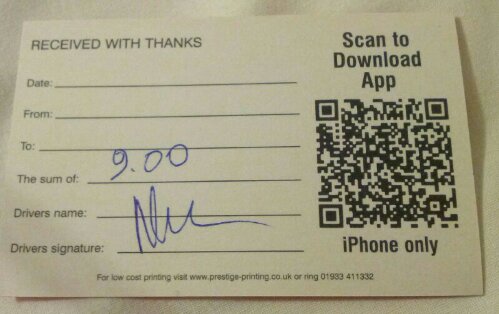
I did something decidedly analogue yesterday; I withdrew cash from a machine. I know, I know, I should have used my NFC enabled smartphone - or my chip & pin card. But it turns out most cab drivers prefer cash. On the screen was one of those ghastly animated adverts. Rather than selling me a mortgage or loan, it was advertising a fast food chain. The ad concluded by telling me to download the…
Continue reading →

Before Cadbury's inaugural hackday began there were a number of rumblings on the blogs about the extact nature of Cadbury's intentions. See Thayer Prime's and Emma Mulqueeny's thoughts on the subject. As it happens, after a bit of gentle poking, some of the terms were clarified. The event itself went rather well, but I'd like to point out a few points where it didn't quite live up to the Hack…
Continue reading →
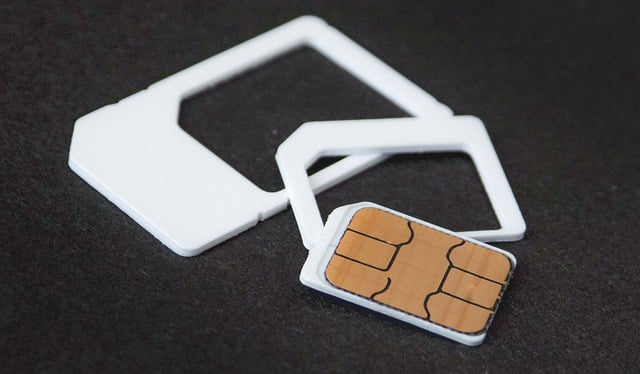
The argument over the nano-SIM is a distraction. It's a sleight of hand designed to catch the industry off guard and fool it into doing something really stupid. The SIM is designed to do a number of things; encryption, address storage, hold SMS, etc. Most importantly, it's designed to be swappable. With GSM, you can choose your phone and your network provider separately. Want the iPhone? Hate …
Continue reading →

I had a chance to play with Senseg's feelable technology today - here's a quick video showing it off. The guys are (naturally) cagey about their product launch, but here's what I was able to glean. It will be multi-touch compatible. The tablet appeared to be Android - that's just the demo unit though. Developer tools will be available. Consumer launch in the first half of…
Continue reading →