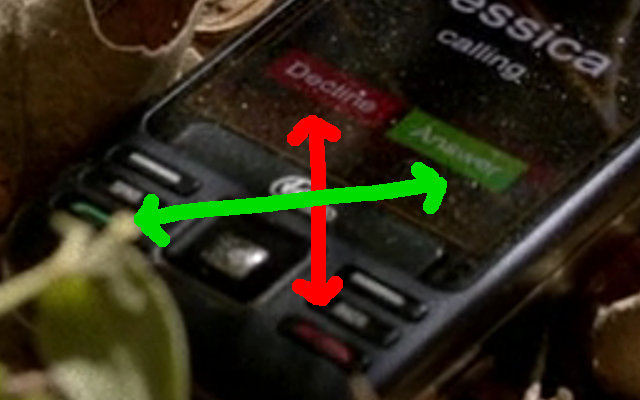
I love the TV Show True Blood. I really only watch it for the insightful social commentary and tasteful depictions of interspecies erotica. And the User Interface mistakes, obviously. During the recent episode "I Found You", the Jessica (the Vampire) places a phone call to Sookie (a sort of telepathic fairy... it doesn't really matter...) Sadly, Sookie has dropped her phone. Notice the…
Continue reading →
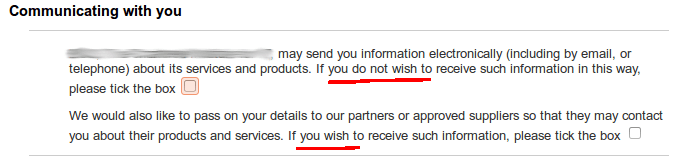
Hanlon's Razor states, "Never attribute to malice that which is adequately explained by stupidity." It would be nice to think that all mistakes and errors we encounter are just the result of bone-headedness. Sadly, that's not the case. Quite often malicious people deliberately try to trick you into taking actions you would normally have ignored. In usability, we call this a "Dark Pattern". A …
Continue reading →

We're all changing our passwords in the light of Heartbleed, right? Good! If you are a developer or designer, I want to explain to you exactly how not to create a password dialogue box for your users. We're all used to seeing this: Input password: Change Password This is incorrect! Why? Because it leads to this? Input password: Change Password ERROR! Your password must be longer than …
Continue reading →

What does the design of cables tell us about the men who invented them? Computer designers often strictly gender the components they create. The most obvious example is the motherboard - the central hub of the computer from which all electronic life descends. As well as circuit boards (often called daughter-boards) - cables are also subject to strict gender rules. The convention is that the…
Continue reading →
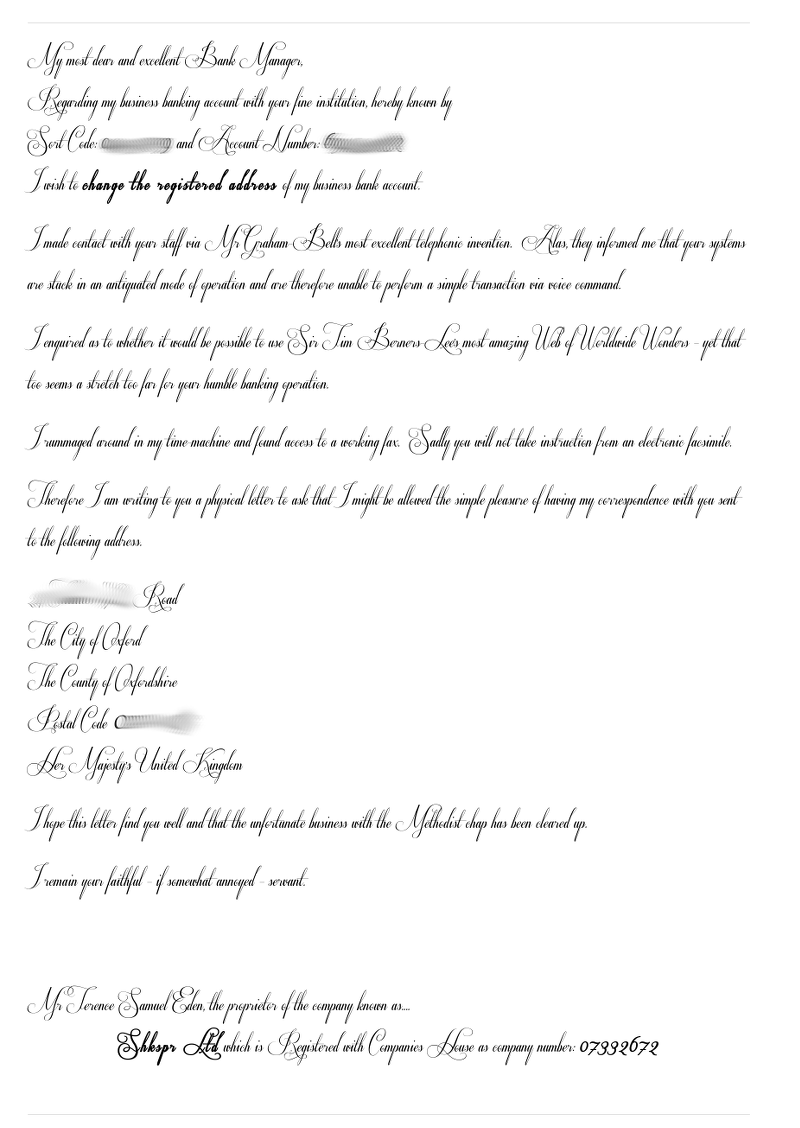
Having recently moved house, I have become very aware of which companies have modern back end systems. The most top-notch ones let me log on to their website, fill in a form, and all the address changes are made. A few required me to ring up and speak to a human being, which was a little annoying, but not the end of the world. Only one company insisted that I write them a letter. Co-Op…
Continue reading →

I'm really late to the party on this one - so this blog post is mostly an aide-mémoire. The web is built on three fundamental components: HTML - the structure of the page. CSS - how the page is styled. JavaScript - the interactivity. Typically, the website owner sets up the CSS to say links are blue, headlines are big, images have borders etc. etc. Users, however, can over-ride …
Continue reading →
In app design, we often talk about designing for the user in context. For example, a taxi app can't rely on a perfect GPS signal in a crowded city, a user in the countryside may not have brilliant bandwidth, battery life is not infinite so we should limit certain features when power levels are low. The common theme in those examples is that we are designing for the phone's context, not the…
Continue reading →

Many years ago, I worked with a chap known only as D.C. That's how he introduced himself, that's how people referred to him, that was his name. Eventually, I asked him what his real name was - and why he preferred "D.C." He replied "David Copeland". For those of you in America - imagine someone being named "Tim McVeigh", or "Ted Kaczynski" I don't think that anyone seriously thought that he…
Continue reading →

It rather sounds like the title of a Doctor Who story from the late 1970s, doesn't it? But it's a term that I think we're going to be hearing a lot of in the future. Jake Levine recently wrote an excellent post on apps which don't require any interaction. It's not quite as crazy as it sounds - the interfaceless application - but refers to a class of program where the only interaction is in…
Continue reading →

Update 2013-07-13 I've just received this email from Nate Tyler at Google. Hope you're enjoying the weekend. I work on the Google Maps team and just saw your post on Google Maps navigation. Thank you very much for the concern. Wanted to be sure you and your readers are aware that we have pushed an update to the latest release of Maps for Mobile to fix this issue. If there's any chance to update …
Continue reading →
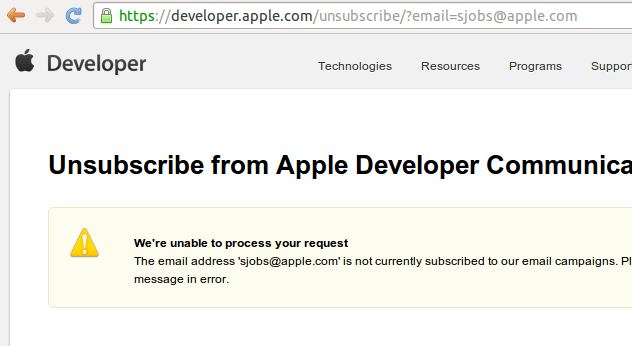
As with most tasks in life, there are two paths you can go by - the easy way, or the right way. Sadly, many of us choose the easy way which, in the long run, means more work for us all. Take, for example, the seemingly dull task of email unsubscription. A developer wants to make it easy for a user to unsubscribe from an email newsletter. They want to place an unsubscribe link at the bottom of …
Continue reading →

There gets a stage in every large company's lifecycle when there are too many people working on a single project. This usually manifests itself in strange internal struggles over the heart of a product as different teams compete for their "vision" to succeed. What often happens is that the user is forgotten and a manager, somewhere, has to make a compromise which sacrifices usability for…
Continue reading →