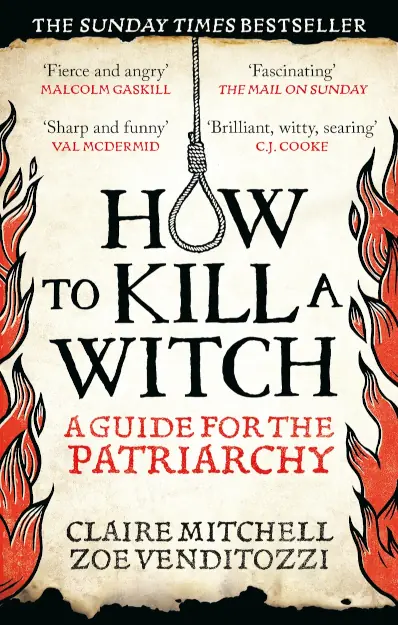
After reading The Wicked of the Earth, I wanted to understand some of the history behind the stories. Why were women0 accused of being witches? What really happened in those trials? What are the modern consequences of those events?
This is the story of the Scottish Witch Trials - with brief forays into England and abroad. It examines the central tension of whether witchcraft was real to the accusers, or just a convenient means to oppress troublesome women. The descriptions of the imprisonment, torture, and state-sanctioned murder is visceral and horrific.
It's also rather stark in its modern assessment of the historic context:
Nonetheless, it’s important to remember it was a proper legal trial, with evidence being put forward and the judge assessing it and carrying out legal tests. Some people think that witchcraft trials were carried out by angry peasants waving pitchforks. Perhaps this is a more acceptable way for a modern person to think about it. No one wants to think that a judicial system can get it so wrong. But it did, with catastrophic consequences for those accused.
The book is mostly good, it's a spin off from the Witches Of Scotland podcast and that's reflected in the writing. As with any parasocial1 entertainment, it attempts to centre the authors and bring the audience along for the ride - so there's lots of descriptions of the libraries the authors visit, how things make them feel, how enamoured they are with their podcast guests. I found it a little distracting, but it's obviously right for their main audience.
Similarly, there's an attempt to bring the past to life by imagining a little monologue from various historic figures. I found that a little unconvincing; I dislike putting words in peoples' mouths. But with sparse primary documentation, that may be the best way to bring these characters to life. It's also well illustrated. Too many books eschew pictures - but this has a nice collection of woodcuts and portraits to contextualise what we're reading about.
One little nitpick, the book makes the claims:
Life was hard and life expectancy was around 35
and
Lilias was an old woman, at least 60 years old and possibly as old as 80. At a time when life expectancy was much lower than it is now, even the lower estimate was still a considerable age.
That's not quite right. Although the average life expectancy was low, that's the average at birth - with a large number of infant mortalities dragging down the average. When you look at the full data, you'll see people used to live long lives even in the distant past.
In a way, it reminds me of Invisible Women. A national tragedy hidden from view.
It builds to a rousing end. There are parts of the world where witchcraft is still taken seriously - with devastating consequences. The febrile atmosphere which led to unfounded accusations against women is still prevalent even in modern societies.
 Ethical Book Search
 Read on Amazon Kindle
 Audiobook and ePub from Kobo
 Used from Alibris
 Listen on Audible
 Buy from an independent bookshop
 Borrow from your local library
 ISBN: 9781800961913


4 thoughts on “Book Review: How To Kill A Witch - A Guide For The Patriarchy by Claire Mitchell and Zoe Venditozzi”
@blog I'd be very interested to read this if it fulfilled your inital questions, despite the style of the book do you feel you understood more about the reality of '
witchcraft in the eyes of the accusers?
| Reply to original comment on mastodon.scot
@jmbmkn @blog
Yes, I think so.
If you're immersed in a culture where the head of state and your local church are telling your that witchcraft is real, why would you disagree with their learned assessment?
While I daresay some accusations were done for petty social reasons, the majority seemed to make innate sense for the community.
The legal process which followed was standard (if not fair) which provided another level of credence.
It wasn't baying mobs with pitchforks.
| Reply to original comment on mastodon.social
Simon
It's difficult to believe that there was a time when people did (and still people that do) actually believe in Witch's and witchcraft. Another similar subject was German and French Werewolf trials ...
Joker_vD
Even today quite a lot of people believe in witchcraft, albeit of arguably different variety, e.g. wiccans. And, of course, belief in nature spirits of all kinds is quite alive and strong in Southeast Asia.
More comments on Mastodon.