
I have a modest set of solar panels on an entirely ordinary house in suburban London.
On average they generate about 3,800kWh per year. We also use about 3,800kWh of electricity each year. Obviously, we can't use all the power produced over summer and we need to buy power in winter. So here's my question:
How big a battery would we need in order to be completely self-sufficient?
Background
Let's take a look at a typical summer's day. The graph is a little complex, so I'll explain it.

The yellow line shows solar production. It starts shortly after sunrise, peaks at midday, and gradually drops until sunset.
The red line shows how much electricity our home is using. As you can see, there's a large peak about 19:00 when we cook dinner.
The blue line shows how much electricity we draw or export from the grid. From midnight until sunrise we import because the sun isn't shining. Once the sun has risen we're able to power our house and export to our neighbours. When we cook, we draw from the grid and our battery - which is why the evening grid peak is lower than the household use dip.
The CSV of the data looks something like this:
| Local_time | Household_(W) | Solar_(W) |
|---|---|---|
| 2025-08-25T08:25:00.000+01:00 | -187.76 | 1166.77 |
| 2025-08-25T08:30:00.000+01:00 | -227.04 | 1193.25 |
| 2025-08-25T08:35:00.000+01:00 | -253.06 | 1222.84 |
| 2025-08-25T08:40:00.000+01:00 | -266.87 | 1245.18 |
| 2025-08-25T08:45:00.000+01:00 | -450.8 | 1268.66 |
| 2025-08-25T08:50:00.000+01:00 | -251.84 | 1281.79 |
| 2025-08-25T08:55:00.000+01:00 | -1426.26 | 1306.93 |
| 2025-08-25T09:00:00.000+01:00 | -206.78 | 1341.37 |
| 2025-08-25T09:05:00.000+01:00 | -215.52 | 1390.9 |
| 2025-08-25T09:10:00.000+01:00 | -242.6 | 1426.19 |
| 2025-08-25T09:15:00.000+01:00 | -246.84 | 1473 |
It's fairly trivial to sum both columns and subtract one from the other. That shows either the excess or deficit in solar power for the household.
On that day, the house used 9.7kWh and generated 19.6kWh. I'd need a 9.9kWh battery to store the excess right? Wrong!
Because my usage doesn't track the sun, I'd actually need a 13kWh battery. That's the peak amount of excess electricity I've generated in that one day.
What I want to do is find out what the maximum size battery I would need in order to store all of summer's electricity for use in winter.
Luckily, I have several years of real data to go off! Let's get started!
Disclaimer
This is based on data generated by my home battery. It has probes to measure solar output and grid flow. It is not 100% clock-accurate compared to my solar-panels' internal reporting nor what my smart-meter reports. I estimate a 1-2% deviation, which is good enough for these purposes.
My energy usage isn't representative of anything other than my usage. Your household is probably different. I already have a 4.8kWh battery which changes how and when I use energy.
This doesn't account for gas heating or hot water. We have some electric heaters and taps which increases our electricity usage.
My maths is probably right - but the code is open source, so feel free to check for yourself.
Remember, this is just a bit of fun. There's no practical way to build domestic batteries with this capacity using the technology of 2025.
Code
We tend to start generating more electricity than we use starting in Spring. So I've picked the end of March 2024 to the end of March 2025.
Let's see how big a battery we'd need to store our summer excess for winter. This finds the cumulative difference between each day's energy production and usage:
Python 3
import os import pandas as pd # Load all the CSVs filepaths = [f for f in os.listdir(".") if f.endswith('.csv')] df = pd.concat(map(pd.read_csv, filepaths)) # Make sure they're in order df = df.sort_values("Timestamp") df = df.reset_index(drop=True) # Resolution is every 5 minutes, so divide by 12 to get hourly df["Cumulative_Difference"] = ( (df["Household_(W)"] + df["Solar_(W)"] ).cumsum() ) / 12 # kWh of battery needed int(df["Cumulative_Difference"].max() / 1000) ## Draw a pretty graph df.plot(kind="line", x="Local_time", y="Cumulative_Difference", xlabel="Date", ylabel="MWh", xticks=["2024-04-01", "2024-05-01", "2024-05-01", "2024-06-01", "2024-07-01", "2024-08-01", "2024-09-01", "2024-10-01", "2024-11-01", "2024-12-01", "2025-01-01", "2025-02-01", "2025-03-01", "2025-04-01"], legend=False, grid=True, fontsize=15) plt.show()
The total is 1,068KWh - basically, a MegaWatt-hour of storage.
Here's a quick graph to show how the storage would be used over the year.
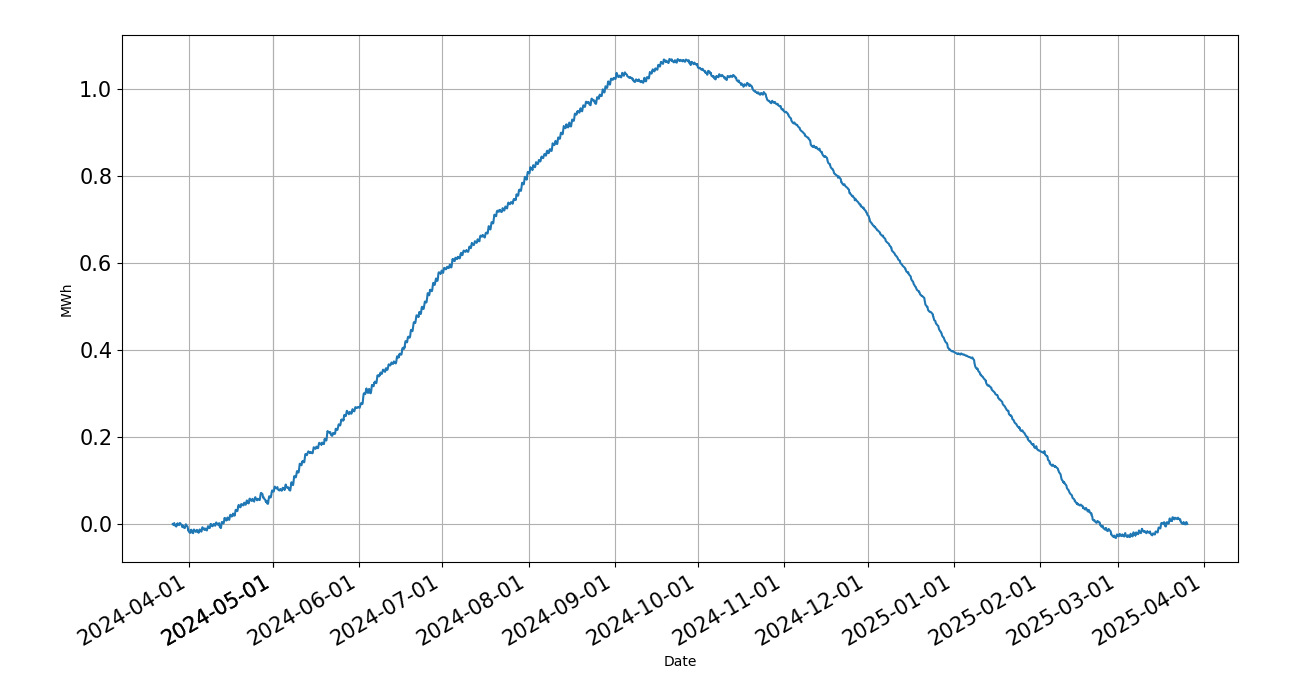
As you can see, even in this scenario there are a few days where we'd need to import energy from the grid.
Is this sensible?
Probably not, no. It doesn't account for increased energy use from having an electric car or moving away from gas heating / cooking. As solar panels increase in efficiency, it might be more sensible to replace the panels on my roof, or add some onto a shed.
The environmental impact of creating and storing such huge batteries could also be factored in.
A battery which is only 100% full for a few days probably isn't an efficient design. Using wind, hydro, and other green sources from the grid might be preferable.
But, remember, this is an exercise in wishful thinking.
Is this possible?
Grid-scale batteries exist and they work brilliantly.
But if I wanted my own MegaWatt-hour of battery storage, it would probably cost me between £100k and half-a-million quid.
That doesn't include maintenance, the land, planning permission, and a hundred other things.
But battery prices are falling fast. In the last decade lithium ion battery prices have fallen 90%. With new sodium ion batteries promising an even bigger drop - down to US$10/kWh.
If - and it is a big if - those numbers came to pass, it would probably cost around £8,000 for a domestic battery. Basically the same cost as adding solar panels in the first place.
Domestic solar works - yes, even in the rainy UK! It is relatively cheap, moves energy production as close as possible to energy consumption, reduces bill-shock, and means we don't have endless planning arguments about whether fields should be turned into solar farms.
It is possible that, not too long in the future, every home could also have a 1 MegaWatt-hour battery. They would be able to capture all the excess solar power generated in a year.
There's a bright and sunny future where every home can be solar-self-sufficient.
If you've enjoyed this blog post, please consider switching to Octopus Energy - we both get £50 when you join.


23 thoughts on “How big a solar battery do I need to store *all* my home's electricity?”
@Edent
Wow, that's bigger than I had estimated. And likely not ecologically prudent to have such a big battery in every house.
| Reply to original comment on mathstodon.xyz
@Edent I have a modest 14KwH of battery storage. Assuming I don’t charge my car, on a sunny day it can get me through the night without hitting the grid. That was two days ago and yesterday respectively — the amount of sun really makes a difference!
| Reply to original comment on mastodon.social
@Edent really interesting. On this side of the pond, 90% of Canada lives south of you. Your numbers show how big an impact household solar could have on our energy needs. It would be nice to see some incentives to build that out.
But solar is woke, so we won't 😞
| Reply to original comment on mastodon.online
How big a solar battery do I need to store all my home's electricity? | Hacker News
| Reply to original comment on news.ycombinator.com
@Edent Here’s some numbers I put together for my southern Ontario home a few years back. On an annualized basis Ontario is a pretty good solar jurisdiction. I still needed over 4MWh of battery to bring my GSHP home through a winter even though on an annual production basis the solarPV was more than enough.
https://energyasicit.ca/solarPVpaper2/
| Reply to original comment on techhub.social
@Edent As a result of my solarPV study and other renewable dataset studies, I concluded that from a climate perspective, there is a better way to use those cheap solar electrons than trying to bridge seasonal gaps on a JIT grid. Vector all those electrons via real time synchronized loads (electrolysers) and direct the H2 to green steel. Save 2x the CO2 compared to dumping electrons onto grid and offsetting fossil power there.
https://energyasicit.ca/EnergyVision/
| Reply to original comment on techhub.social
Big Sol
Have you considered doing the sum for an arbitrary large array of solar panels ? I believe it is cheaper to oversize panels (even on badly overcast days they do produce a bit of power) than batteries.
And then one can combine them with a larger battery to work out the optimal balance too.
On the worst foggy / rainy days in London my current panels can generate less than 0.5kWh - see https://solar.bots.edent.tel/post?id=677566fb-e55d-f951-9f92-4799f2790e13
So I'd need something like 20x more panels (or for them to be 20x more efficient) to generate a full day's worth of electricity.
As I say in the post, my roof is full. There's also not any room in the garden for them.
But, yes, more panels is always likely to be more useful than more batteries.
BrightCandle
Wit the current economics it's much cheaper to overproduce your needs over the year and use considerably less battery. Twice as much solar gets you much deeper into winter and in practice on average winter in the UK is about 1/6th the power so it's much cheaper to go for days of battery storage only and a lot more panels.
@Edent Thanks for going through the math. People heavily underestimate how much one needs to overprovision solar + batteries on higher latitudes. Near the equator, without seasons, solar + batteries is going to become a no-brainer soon.
| Reply to original comment on society.oftrolls.com
At a ThingMonk in maybe 2017 or 2018 Tom Rafferty talked about how you could combine batteries with time–of–use billing from the grid to maximize the utility of solar + batteries. Basically you'd top off the batteries with your solar during the day but otherwise sell excess energy to the grid and, if available, use time–of–use energy drawn from the grid to recharge the batteries overnight (theory being that electric overnight would be significantly cheaper than energy drawn during the day). Not as clean as purely solar to battery, but ensures that you have battery to draw on instead of the more expensive grid on the days that you're not meeting your needs with solar.
That is exactly how we use our battery - https://shkspr.mobi/blog/2024/01/we-pay-12p-kwh-for-electricity-thanks-to-a-smart-tariff-and-battery/
When the price of electricity is low, the battery slurps it up. When the price is high, it discharges it.
J S
.
buy several used panels and make a high angle array pointing directly south for mid winter.
I split my array into two segments, V pattern, east and west ends moved north 23.5 deg to grab more energy am/pm while smoothing mid-day. it's a ten month owner grid, adding a modest south facing array gets to twelve months.
used panels are cheaper than batteries or inverter.
.
As I say, my roof is full. While panels are cheap they also require an inverter to work with domestic electricity. In the UK there are limits to how much you can connect without prior approval.
Dom
Interesting. I've done a rough figure for my generation and usage and I reckon I could just about get away with a 650kWh battery. I used daily generation and usage figures rather than the 5-minute ones as any decent sized battery will smooth out the values anyway.
In truth I could probably just get away with 500kWh if I were to go 100% off-grid, as my usage is artificially high on days when Octopus Agile has negative unit rates.
I'd still be reliant on gas for heating and cooking though.
As someone has suggested, more panels would help, but like you I've got the maximum I can fit on my roof and nowhere else suitable for a permanent fixture.
Rafael Goulart
Here in Brazil we can use the power grid as "storage". We send the excess to the them and they do the balance between what they provide and what we sent (although companies lobbied to be allowed to charge a small fee for this storage service).
So summer solar power is used in winter, and we can even share it with another home (using the same power company).
We do the same in the UK 😄
Anthony Cartmell
Batteries are excellent short-term storage (hours), but expensive for long-term storage (months).
Heat storage using silos of sand are the other way around. Especially if you have a need for heat in winter.
The speed of charging and discharging is less important for long-term storage, so long as you have a day's worth of high power storage available.
Dr Mike
Can you elaborate how did you arrive at the $100k battery storage for 1MWh?
I linked to a company selling Fogstar 32kWh batteries for £3,400. (1,000kWh / 32kWh) x £3,400 = £106,250.
I'm assuming they might give me a generous discount if I buy in bulk 🙂
Neat breakdown with data + some code.
| Reply to original comment on lemmy.world
Andrew
I did this exact exercise before buying our battery. I also did some testing on payback time and got a really interesting S shaped curve with the 2 inflection points around the average daily usage and average seasonal usage. Between these points there was an almost flat line where you got very little extra return. My other takeaway was that we would get the most benefit from having the first KWh of storage provided it can it has about 3KW peak output. We have ended up with a 5.1KW peak solar array, 10KWh (usable) battery with 6KW peak output which means we can live "off grid" From the end of May till mid September except for car charging. Adding more solar panels would extend this further and the garage roof looks prime for this when money allows.
David
I am very interested in the Sodium batteries and even more interested in sand batteries being a heat storage for the winter from solar panels built into the design of new builds if that is possible.
More comments on Mastodon.
What links here from around this blog?