


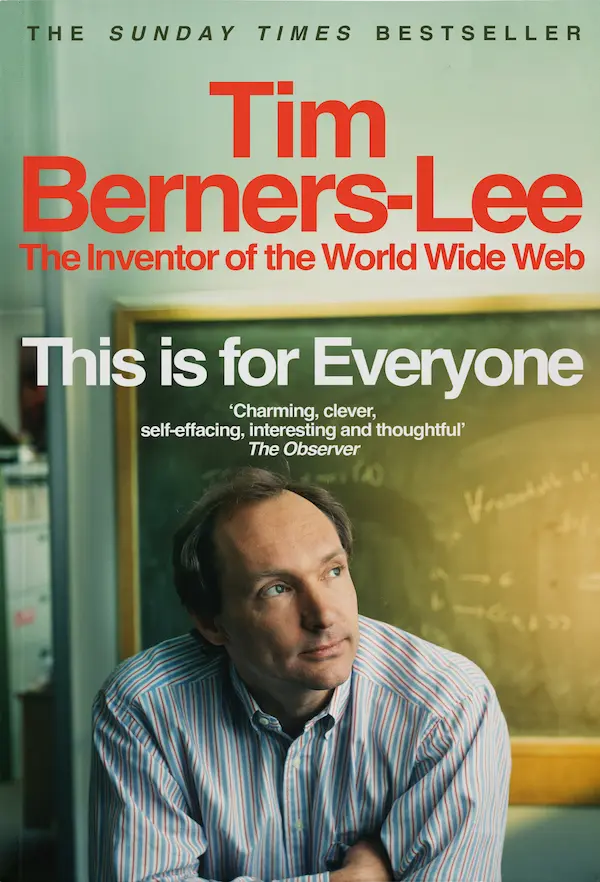
Is this a biography of a man, or of his mission? Is this the story of how the web came to be, or a lament for what happened to it? Do you crave the inside gossip, or the PR sanitised gloss?
This Is For Everyone, but I think it ends up being slightly unsatisfying for anyone.
It starts with the normal charming family anecdotes. No grand revelations or hidden secrets, just a lovely ramble through growing up. It's hard to write a memoir without delving in to some of the frailty that makes us human. I wasn't expecting a "tell all" or histrionics, but divorces are waved away in half a sentence and the emotional aspects of life as the inventor of the web are almost totally absent.
Where his emotions shine through is the constant undercurrent of rage and disappointment at how the web has been corrupted.
those operators turned the supposedly non-profit DNS address system into a nauseating free-for-all. Domain names would become an asset class for investors, rather than a tool for innovators
[…]
DNS fell into the hands of some rather unscrupulous operators. What had been an unremarkable piece of back-end internet infrastructure was temporarily transformed into a revolting for-profit bonanza.
He is unashamedly catty about some of the villains of the piece. I won't regurgitate their names or give them the oxygen of publicity, but it is nice to see a senior tech figure call out some of the madness and harm caused by others. Similarly, he is harsh in his criticism of how some browser vendors have behaved. We can argue about whether XHTML was a mistake, but the "moat" of working with non-standards compliant pages makes for a successful monopoly.
It isn't exactly a whinge, but you can hear the exasperation in his tone. He gave the world a magnificent gift and some people are trying to poison the well for all of us.
A few chapters are dedicated to the rise of AI - and its perils. Similarly the tension between addictive algorithms and staying sane. These are certainly interesting thoughts, but perhaps belong in a different book. Memoirs are, typically, not about the future.
A large part of the book is taken up with Tim's "difficult second album" - Solid. I desperately love the idea of Solid - keeping your data personal and only allowing access for explicit and limited purposes. But I also think it is becoming clear that most people just don't care that much and, even if they could be bothered with all the admin, there's no signs that businesses want to get involved with it.
At times, it feels like the book is mostly a pitch document for why Solid is the future. Again, not exactly what I was expecting from a memoir.
I think every single part of this book is good - the personal memoir, the history of the web, the future of tech - but as a whole they feel a little disjointed. I think I'd rather have read three different books rather than have them jammed in together. I suspect the hard-core geeks will skip the domestic stuff and the average reader will be somewhat baffled by the dive into deepfakes and Mastodon.
It does, however, contain a message of hope. The web is still here and it will last in one form or another for eternity. We have to keep working for it though.
[M]y work with Danny Weitzner had shown me that it was not enough simply to release new technology and hope for the world to improve. You had to develop technology and society together. You really had to fight, in a principled and continuous way, for human rights.
We need that tattoo'd inside the eyelids of every tech executive who has tried to subvert the web for their own ends.
 Ethical Book Search
 Read on Amazon Kindle
 Audiobook and ePub from Kobo
 Used from Alibris
 Listen on Audible
 Buy from an independent bookshop
 Borrow from your local library
 ISBN: 9781035023707


