
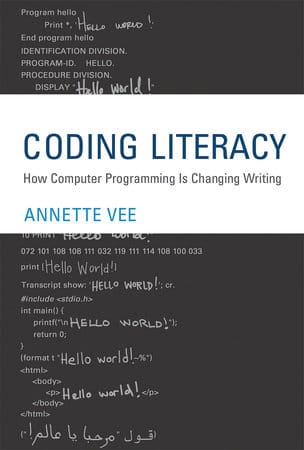
This is a disappointing and frustrating book - not least because it so nearly hits the mark.
The subtitle is "How Computer Programming Is Changing Writing" - but it never gets close to discussing that topic, let alone deeply examining it. Instead, it is a book mostly focussed on the history of what we mean by "literacy" and, by contrast, what it meant to be "illiterate".
As per the standard for academic monographs, it is more interested in endlessly discussing the semantics of a term than engaging with its impacts. The historic stuff is genuinely fascinating. But the endless diversions about what Academic A thinks and how Academic B rebuts is a little tedious. There are clear parallels between a pre-literate society relying on the village scribe and the modern family having that one cousin who "knows computers" - but it is only weakly explored.
There are moments when it seems like the author is really going to delve in to what coding literacy actually means:
The relationship between programming as a practice and computer science as a discipline is a central tension in the contemporary programming campaigns that invoke literacy,
But it rarely goes beyond surface level. Most people can write - but only few can write a novel. Many can engage is literary criticism - but few take it any further. How does that model fit on to coding? The book doesn't discuss, but there's an easy parallel there. Only a few people can write an app, but many can use it. Anyone can write a review of an app, but not many can do so from a position of literacy.
This was published in 2017, so written a decade or so before LLMs became seemingly ubiquitous. Nevertheless, there are some historic titbits which seem to fit nicely into today's world:
As early as 1961, Peter Elias claimed that training in programming languages would soon cease because “undergraduates will face the console with such a natural keyboard and such a natural language that there will be little left, if anything, to the teaching of programming. [At this point, we] should hope that it would have disappeared from the curricula of all but a moderate group of specialists.”
But, as the book does briefly discuss, the way the brain is changed by coding literacy forces people to think more in line with a computer. Even if you tell an LLM "build me an app to do xyz", you still need to think about what you're doing, why you're doing it, what edge-cases you need to consider, etc.
But then it is back to the interminable academic squabbling about whether Wittgenstein's definition of an inconsequential term is compatible with Chomsky's.
Perhaps the biggest weakness is that there is almost a complete absence of code! A few examples of BASIC would have done so much to demonstrate how a restricted language set changes how people write and therefore think.
There's a brief exploration about how the typewriter and typesetting changed language and literacy - but where's the examination about how the tyranny of ANSI layout curtailed the way programmers wrote? There's an amazing exploration to be done about why coders use => rather than → and how various other symbols got co-opted into their languages.
Instead, it is back to the history books again.
Here's another good example about how writing changed literacy:
Written texts provide fewer cues than oral delivery about how to “take” them; for example, ironically, sincerely, or jokingly. Readers must interpret texts, supplying the illocutionary force of the text themselves.
It seems obvious to me that this is directly comparable with something like a code review. It isn't immediately clear what a programmer means when they write something down - and even comments can be misleading. What sort of "oral traditions" are we building up?
The book then mostly abandons any pretence of talking about code. I think the author really wanted to write a history book but needed the (then) coolness of tying it to the various "get kids to code" campaigns.
Towards the end, it almost returns to the topic at hand.
We choose our words in terms of what is potentially reportable on Facebook or Instagram or Twitter
[…]
Although few people know how to program the devices on which code and computation ride into our lives, their manifestations influence us anyhow. In various ways, we have learned to see ourselves as “computed” by the devices and networks on which we depend.
As we might say nowadays "Hey chat! Guess the Cheeto didn't unalive himself today!" - but that isn't really about coding. The people using those substitute words are ignorant of how algorithms really work and think that their clever doublespeak can bypass censorship.
We desperately need more people to be literate in what coding means. Sadly this book only every lightly touches on what coding literacy does to our language, our thoughts, and our society.
I'm giving it 2.5 stars because the history was genuinely interesting - but it completely fails to engage with the topic it promised.
 Ethical Book Search
 Read on Amazon Kindle
 Audiobook and ePub from Kobo
 Used from Alibris
 Listen on Audible
 Buy from an independent bookshop
 Borrow from your local library
 ISBN: 9780262340229


