
The NHS is preparing to close nearly all of its Open Source repositories.
Throughout my time working for the UK Government - in GDS, NHSX, i.AI, and others - I championed Open Source. I spoke to dozens of departments about it, wrote guidance still in use today, and briefed Ministers on why it was so important.
That's why I'm beyond disappointed at recent moves from NHS England to backtrack on all the previous commitments they've made about the value of open source to the UK's health service.
It's rare that multiple people leak the same story to me, but that's what gives me confidence that lots of people within the NHS are aghast at this news.
A few days ago, I was sent this quote which was attributed to a senior technical person in NHS England.
We are obviously looking at things like Mythos, which is more sophisticated at finding vulnerabilities. In the next week or so, we will be changing our tack on coding the open and making our code public until we're on top of that risk.
Most of our repos, unless they're essential, will be removed for security reasons.
As I've written before, this is not the correct response to the purported threat by Mythos. Neither the AI Safety Institute nor the NCSC recommend this action. While there may be some increase in risk from AI security scanners, to shutter everything would be a gross overreaction.
Nevertheless, that's what the NHS is preparing to do.
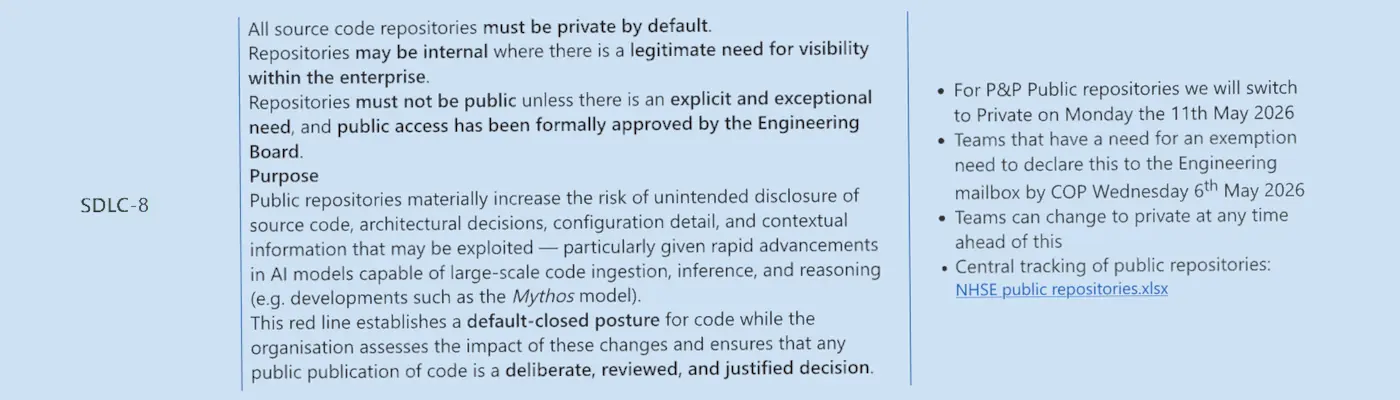
On the 29th of April, guidance note SDLC-8 was sent out. Here's what it says:
The majority of code repos published by the NHS are not meaningfully affected by any advance in security scanning. They're mostly data sets, internal tools, guidance, research tools, front-end design and the like. There is nothing in them which could realistically lead to a security incident.
When I was working at NHSX during the pandemic, we were so confident of the safety and necessity of open source, we made sure the Covid Contact Tracing app was open sourced the minute it was available to the public. That was a nationally mandated app, installed on millions of phones, subject to intense scrutiny from hostile powers - and yet, despite publishing the code, architecture and documentation, the open source code caused zero security incidents.
Furthermore, this new guidance is in direct contradiction to the UK's Tech Code of Practice point 3 "Be open and use open source" which insists on code being open.
Similarly, the Service Standard says:
There are very few examples of code that must not be published in the open.
The main reason for code to be closed source is when it relates to policy that has not yet been announced. In this case, you must make the code open as soon as possible after the policy is published.
You may also need to keep some code closed for security reasons, for example code that protects against fraud. Follow the guidance on code you should keep closed and security considerations for open code.
There's also the DHSC policy "Data saves lives: reshaping health and social care with data":
Commitment 601 – completed May 2022
We will publish a digital playbook on how to open source your code for health and care organisations
And, here's NHS Digital's stance on open source in their Software Engineering Quality Framework:
The position of all three of these documents is that we should code in the open by default.
All of which is reflected in the NHS service standard:
Public services are built with public money. So unless there's a good reason not to, the code they're based should be made available for other people to reuse and build on.
All of which is to say - open source should be baked into the DNA of the NHS by now. There are thousands of NHS repositories on GitHub. The work undertaken to assess all of them and then close them will be massive. And for what?
Even if we ignore the impracticality of closing all the code - it is too late! All that code has already been slurped up. If Mythos really is the ultimate hacker, hiding the code now does nothing. It has likely already retained copies of the repositories.
And if it were both practical and effective to hide source code - that doesn't matter. These AI tools are just as effective against closed-source. They can analyse binaries and probe websites with ease.
There are tens of thousands of NHS website pages which refer to their GitHub repos - will they all need to be updated? What's the cost of that?
I've no idea what led to NHS England making this retrograde decision - so I've send a Freedom of Information request to find out.
I am convinced that closing all their excellent open source work is the wrong move for the NHS. I hope they see sense and reverse course.
Until then, I've helped make sure that every single NHS repository has been backed up and, because the software licence permits it, can be re-published if the original is closed.
In the meantime, you should email your MP and tell them that the NHS is wrong to shutter its world-leading open source repositories.
Don't let them take away your right to see the code which underpins our nation's healthcare.
Further Reading
- I'm quoted in this article from The New Scientist.
- Matt Hancock on the issue
- Discussion by Jessica Morley, PhD
- Free Software Foundation Europe press release
- Further commentary from New Scientist
- Petition - Keep Things Open
- Update 2026-05-14: GDS have published their Guidance "AI, open code and vulnerability risk in the public sector " which explicitly says closing repos is the wrong approach.


44 thoughts on “NHS Goes To War Against Open Source”
@blog When will the suits learn that security through obscurity is no security at all?
| Reply to original comment on mastodon.social
@lordmatt @blog I'm getting a strong vibe here that we should do everything within our power to prevent senior managers from being taken out to lunch by genAI salesbros
| Reply to original comment on martinh.net
@blog Do these people even realise you don't need to access to source code to exploit vulnerabilities? (fuzzing, scanning binaries for vulnerabilities, buying 0-day breaches… You name it…)
| Reply to original comment on mamot.fr
@Edent Thank you for highlighting this, and without any unnecessary hyperbole!
A hugely retrograde step; I'll certainly be writing to my MP on the matter.
| Reply to original comment on social.crablab.uk
@Edent Ugh. Where I work it’s even worse – very little has ever been open sourced, but at least it was easy to share code internally. Recently our internal Gitlab has been reconfigured to remove the ability to set repos to “public” (anyone on the network) or “protected” (anyone signed into Gitlab), and only allow “private” (specific people or groups). Not just “default closed”, but “only closed”.
| Reply to original comment on mastodon.social
@blog thanks for the post. Was an interesting read. It will be interesting to see how this progresses as NHSE winds down and is absorbed by the dept of health.
Does seem a move with little upside and lots of cost/confusion.
| Reply to original comment on mastodon.online
It looks like this may have been in the works even pre-Mythos: http://www.digitalhealth.net/2025/12/nhs-...
"A source working with NHSE told Digital Health News that the policies had been removed because of security concerns and because NHSE does not believe it has the capacity to maintain [OSS]"
| Reply to original comment on bsky.app
@Edent Even with the recent Copy Fail exploit being revealed, this is an extreme measure, to put it mildly.
#FOSS #Linux
fosslinux
| Reply to original comment on c.im
@Edent good thing they are all archived in @swheritage https://archive.softwareheritage.org/browse/search/?q=GitHub.com%2Fnhse&with_visit=true&with_content=true
| Reply to original comment on mastodon.social
Sal
If this goes through, it would demonstrate an immature understanding to a mounting vulnerability problem, so it gives me a concern on two fronts: 1) the NHS is expected to reduce it's budget globally by 2% for the next several years and proprietary vendors will slow that timeline 2) more worrying, is the fact that this is simply not how vulnerability protection works. The issue is not whether they can read the code on an open source repository, it is knowing what the lockdown method for the specific server and chip that it lives on and supporting jurisdictional requirements and software sandboxes where needed. 3) The third bullet point no one asked for: Mythros has the ability to look at vulnerabilities, trace them down to the binary, and then review that sequence from other stacks. If this was immunology, this would be interspecies contagion, and that's new to software and it's quick. Mad Cow Disease Mythros.
Contagion and isolation protocols are beginning to emerge, but open source spreads as a social contagion, so harder to truly stop the downstream effects from spreading in this moment. NHS is a downstream effect. Removing Open Source doesn't stop the threat, it likely makes these services more vulnerable to stale updates to patches. This is one of those rare occasions where talking about the actual reality of the consequences of this to an MP is important.
@blog I am getting so tired of utterly unfounded hyperbole around this tool. No, it is NOT that effective. Tech world has lost its integrity and calm in face of technical difficulties.
| Reply to original comment on toot.lv
@Edent great write-up. There's an additional point (made by Bruce Schneier writing on "vulnerability economics"): it's very plausible that in the arms race between AI offence and defence that open source will have the edge, because everyone can collaborate on the defence of such software
https://www.schneier.com/blog/archives/2026/04/cybersecurity-in-the-age-of-instant-software.html
Cybersecurity in the Age of Instant Software - Schneier on Security
| Reply to original comment on universeodon.com
Story broken by New Scientist today, but it’s been in the unofficial rumour mill all week for those working inside NHSE. Terence Eden has put out a good explanatory blog post There is an open letter if you feel you would like to sign and share it.
| Reply to original comment
Saw this interesting blog post today about how the NHS is apparently preparing to shut down all Open Source repos in response to models like Mythos posing a security risk. Sad to see this response from the NHS. Interestingly, the Linux kernel vulnerability I posted the other day was partially identified by AI. I can see why there’s a kneejerk reaction to close repos, but think it demonstrates a misunderstanding of cyber-security to move ahead with the idea… The code’s already out there; the mod...
| Reply to original comment
NHS Goes to War Against Open Source | Hacker News
| Reply to original comment
@Edent oof that's disappointing.
| Reply to original comment on fosstodon.org
As you highlighted, this clearly violates the NHS #ServiceStandard, which states in its points 12 and 13:
service-manual.nhs.uk/standards-an...
| Reply to original comment on bsky.app
@blog This is all kinds of stupid. Fuzzing exists. https://us.artechhouse.com/Fuzzing-for-Software-Security-Testing-and-Quality-Assurance-Second-Edition-P1930.aspx
| Reply to original comment on mastodon.social
Horrified to hear that NHS England is ignorantly closing their #OpenSource repositories "for security reasons".
https://shkspr.mobi/blog/2026/05/nhs-goes-to-war-against-open-source/
#UKPol
| Reply to original comment on meshed.cloud
| Reply to original comment
A disaster of a week where I got ill.
| Reply to original comment on tomcw.xyz
@blog
This is somebody letting the wolves in through the back door. Open source tools are the only real shot at independence, transparency, or safety. The alternative is letting in the technofascists-- any chance of privacy, GONE. All your medical data, right down the gullets of surveillance-hungry eugenicists.
| Reply to original comment on kolektiva.social
@blog This is unfortunate, the NHS' OpenNext.js Terraform Module was quite helpful, and was a good look into how someone runs OpenNext at scale.
| Reply to original comment on hachyderm.io
Теренс Иден, участвовавший в продвижения открытых стандартов и открытого ПО в госучреждениях Великобритании, сообщил , что Национальная служба здравоохранения страны (NHS) готовится закрыть почти все...
| Reply to original comment
Today's links Demand destruction vs fuel-superceding infrastructure: Will Trump hormuz us into the full Gretacene? Hey look at this: Delights to delectate. Object permanence: Beck,…
| Reply to original comment on pluralistic.net
Terence Eden reports that the UK's National Health Service (NHS) is preparing to close almost a [...]
| Reply to original comment
Chris
Flagging https://publicsectorcodebyorg.co.uk/org/nhs-england/ (disclosure - my site!) as a way of seeing all public repos from NHS England across its several GitHub organisations
Pinboard: URL page for https://shkspr.mobi/blog/2026/05/nhs-goes-to-war-against-open-source/
| Reply to original comment
Seems to be a pattern of our day and age? Keeping an open public #archive available becomes an act of civil disobedience."I am convinced that closing all their excellent open source work is the wrong move for the NHS. I hope they see sense and reverse course.Until then, I've helped make sure that every single NHS repository has been backed up and, because the software licence permits it, can be re-published if the original is closed."#NHS #OpenSource #ArchivesUnderPressure
| Reply to original comment on openbiblio.social
@Edent It's a pity that news of the BOSCO ruling don't seem to have reached the UK's NHS.
https://civio.es/novedades/2025/11/17/this-is-the-landmark-ruling-that-sets-a-new-standard-for-algorithmic-transparency-in-spain/
This is the landmark ruling that sets a new standard for algorithmic transparency in Spain
| Reply to original comment on mastodon.social
A sharp, readable newsletter on NHS policy, digital health, and public service reform. Smart insights written on very little sleep.
| Reply to original comment on www.thebevanbriefing.com
@Edent when in govt or similar roles I always found it very hard to pin down a specific person (or team) that would actually make such a decision - everyone seemed to think it was someone else’s call
I wonder if anyone will actually own this one
| Reply to original comment on hachyderm.io
England’s National Health Service (NHS England) is preparing to make most of its public source code repositories private by default, according to recent re...
| Reply to original comment
@Edent Shocking. Terrible waste in multiple ways.
| Reply to original comment on ioc.exchange
@blog fighting a darn good fight!!
(The NHSX repo I contributed to during the pandemic is still online, though maybe not total surprise because the project is obsolete 😅)
| Reply to original comment on fosstodon.org
More comments on Mastodon.
Trackbacks, Pingbacks, and Boosts
[…] in the land of my birth, there was some notable groans when the National Health Service decided to close nearly all of their Open Source repositories, supposedly to the security threat of LLMs. Closing repos like this isn’t an effective counter to […]
[…] on the grounds that they expose the service to the threat of AI hacking, as former civil servant Terence Meaden reports. In a second posting, Meaden deplores the decision and points to significant dissent from the […]
[…] NHS Goes To War Against Open Source – Terence Eden’s Blog […]
[…] very useful to me. There is a lot of discussion about Mythos and security testing, including some panic actions by the NHS; in that regard, the Curl team’s experience with Mythos is interesting. Overall, industry […]
[…] https://shkspr.mobi/blog/2026/05/nhs-goes-to-war-against-open-source/ […]
[…] closed off, especially given who’s now sitting inside it. Forward this article, or one of Eden’s two24 on the same subject, to anyone you know who works in tech, government, or healthcare. They will […]
[…] convinced that closing all their excellent open-source work is the wrong move for the NHS,” he said. “I hope they see sense and reverse […]
The NHS is planning to move from an open source software development model to a closed one due to fear of Mythos. As far as unintended consequences go, this is a big one, it's terrible, but it's not entirely surprising. The PR around Mythos has been threatening that the sky is falling, the world is ending, and millions of vulnerabilities will be found in the coming months (or even weeks) - so, is it really surprising that some organisations are making knee-jerk reactions?
Now is a time for level heads and proper analysis, not knee-jerk reactions. "Keep calm and carry on" for lack of a better meme.
Given that the sky probably isn't about to fall in on us, if you're in the UK please sign the petition at https://keepthingsopen.com urging the NHS not walk back on their commitments to open source.
I also recommend the blog post "NHS Goes To War Against Open Source" by @Edent on this subject: https://shkspr.mobi/blog/2026/05/nhs-goes-to-war-against-open-source/
#OpenSource #AI
NHS England is temporarily restricting access to some of its open source code to strengthen security amid concerns about the impact of AI models.
[…] been reported that NHS Digital / England will reverse course on publishing the source code and close […]
En plus de l’assault des robots sur toute l’infrastructure des communs, il faut maintenant ajouter les fermetures de logiciels. Sale temps pour l’open source et l’open access ! #openAccess #commons #ia
Unsurprising to see that while more and more of Europe is embracing - nay, mandating! - open source, our government is proving once again that it cares so very very little about doing anything to help others.
Luckily there are lots of people out there (including Terence) who are trying to plug the technical and moral holes politicians are so good at making.
"Most of our repos will be removed for security reasons"
they do know that... once it's on the public internet... it's on the public internet...
"senior technical person" is the bar really that low? how the fuck am i still unemplyeod
RE: https://shkspr.mobi/blog/?p=70760
Anthropic's breathless press releases about its vuln-scanning bot have kinetic effects that reduce security for everyone.
Anthropic is a bad actor in the space.
"The #NHS is preparing to close nearly all of its #OpenSource repositories." - https://shkspr.mobi/blog/2026/05/nhs-goes-to-war-against-open-source/ this is utterly insane; if you are in the UK, please write to your MP explaining why this is so stupid - https://www.writetothem.com/
What links here from around this blog?