

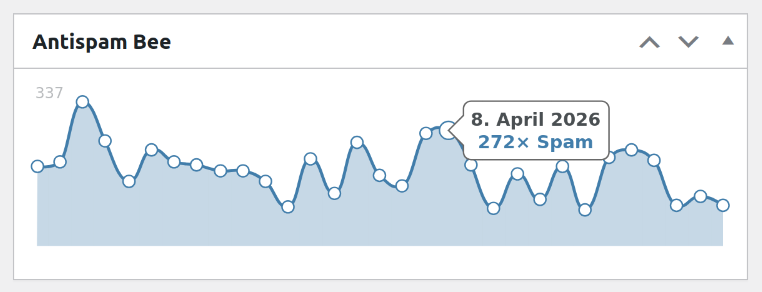
I'm grateful that my blog posts attract lots of engaged, funny, and challenging comments. But any popular post also attracts spammers. I use Antispam Bee to automatically eradicate a couple of hundred crappy comments per day.
Nevertheless, some get through. Here's a particularly pernicious one - it appeared as three comments ostensibly in reply to each other.
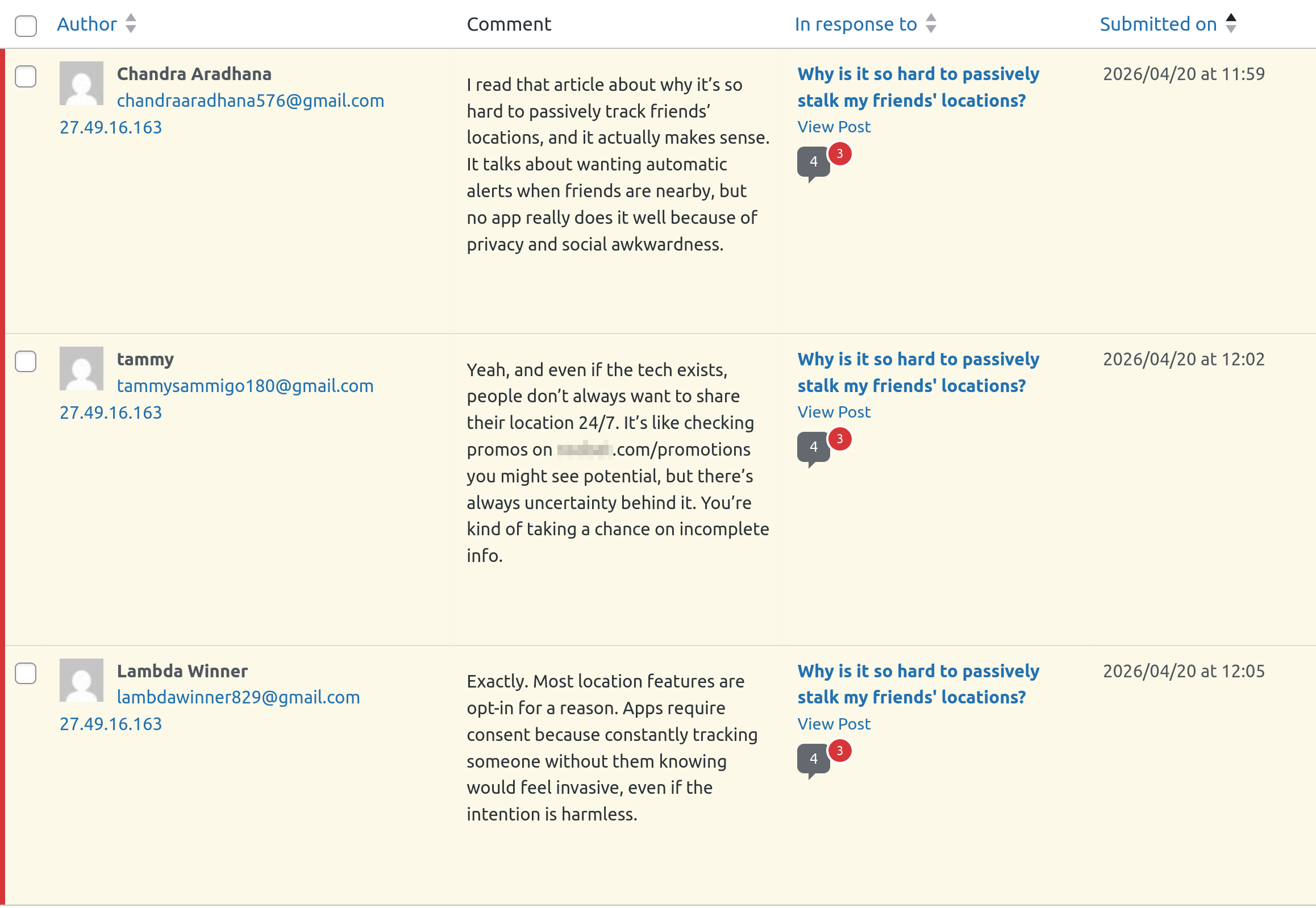
At first glance these look like normal comments. They each address the content of the blog post albeit somewhat superficially. The first comment looks like it was from a social media post sharing my link - I get a lot of those as pingbacks, so it initially didn't trigger any suspicions from me.
The second is ostensibly a reply to the first and continues the conversation. Again, a bit shallow, but seems to be engaging in good faith.
The third looks like yet another reply. They all have unique email addresses, none of them have set their username to anything overly odd, and none of the users have filled out their URl.
But notice, in the second one, there's a link to a dodgy casino! There's no https:// so it didn't jump out as a link.
All three came from the same IP address in the Philippines, so easy to block for now.
Each reply is spaced exactly 3 minutes apart which, in retrospect, looks a little odd.
Re-reading them carefully, they all look like AI slop. A plausible sounding summary, written in a casual style, but with very little semantic content. Seeing them as replies to each other primed me to think they were genuine because I'm used to spam coming in individual replies. Having the spam in the middle comment made it easy to glaze over.
Remember, there are no technological solutions to social problems. Sticking more and more barriers in the way of commenting only discourages genuine replies while the profit motive incentivises spammers to work around them.


11 thoughts on “Sneaky spam in conversational replies to blog posts”
@blog It might be AI slop, but I've definitely seen this sort of low-content reply that looks like a real comment before that was a thing, these are from 2018/19 and I assume it's to promote the universities in the URL in a weird way.
| Reply to original comment on teh.entar.net
@eythian @blog Probably less to promote it directly; more to spread it widely across multiple platforms to drive up the search ranking. (Admittedly I am no expert, but that would be my inference.)
| Reply to original comment on mastodon.me.uk
Sneaky spam in conversational replies to blog posts | Hacker News
| Reply to original comment
Jack Beagle
@blog the ones in your screenshot are pretty good because they are a bit more conversational. I use SpamPatrol.io myself because generally these types of spam messages will be trying to promote something specific but outside of the second message in your example it might have still snuck through. As the LLMs get better the spam messages will certainly get better.
helllo
I read this article about sneaky spam in conversational replies and it touches on interesting point. It's like we're getting closer to the reality of xkcd.com/810/ 😉 "Remember, there are no technological solutions to social problems" - I don't know, conventional captchas kind of worked for most websites for a long time?
LLMs are better than humans at solving CAPTCHAs now:
https://futurism.com/the-byte/ai-better-solving-captchas-prove-human
Joda
This format is insanely abundant in YouTube comments, at least in certain subjects. You'll see comment 1 "Oh I have this huge problem [tangentially related to video subject], comment 2 "I also had that problem, until I found [website, person]”, comment 3 "Me too!" Etc
Reddit has had astroturfing and rep farming for a very long time. X is almost completely AI slop. Dead Internet Theory is becoming increasingly real, with the exception of blogs of people who enjoy writing.
John
My working theory is that it's because some anti-spam measures use unblocked comments as a signal that the comment source is legit. So you trickle comments a few at a time to a blog, all innocuous, and then once you think you've built enough reputation, you start posting the actual spam.
Mary Claire
I read that article about spam in blog comments. I also have faced this with my personal blog, but ever since I found out about Zombo com, all my problems are gone.
Hey, as one of the actual people behind Antispam Bee, I can say we’re always interested in patterns like this to improve the plugin's detection and keep up with bad actors.
I know we currently have a discussion on GitHub about a similar problem and might end up doing some patterns for the email addresses.
Thanks for using our plugin. ❤️
Ugh. So depressing. Spam whack-a-mole is a never ending game. I'm glad there are people still fighting the good fight, but it does feel a bit like a losing battle to us non-technical mere mortals.
More comments on Mastodon.
Trackbacks, Pingbacks, and Boosts
Title: "Conversational Replies to Blog Posts"
https://shkspr.mobi/blog/2026/04/sneaky-spam-in-conversational-replies-to-blog-posts/
Anecdotally, I've been getting a lot of these on my blog for what seems like years. My rant about the difficulty in finding a chair I liked, along with that mid-century architecture desk seem to particularly attract a lot of them. That desk chair one in particular, from one particularly persistent bot! (I wonder if it will only stop when I let one of its comments remain, but with the contents blanked?)
Anyway, this is a very real problem these days...
Sloppified enshittification and all! 🙄