
Alt text is great. It allows people who can't see an image to understand what that image represents.
For example, the code might say: <img src="whatever.gif" alt="Two cute kittens are playing on a blanket">
If you are blind, you get an idea of what's being conveyed by that image. If you're on a train and the WiFi craps out just before the image loads, you'll also benefit! If the image is of text in a language you don't read, your device can translate it for you.
The alt text can be as long or as short as is necessary. It might just be "kid giving a thumbs up" or it could be incredibly detailed. Here's how the BBC's Newsbeat typically adds alt text for younger viewers:

Is that too much? Maybe. It depends on your audience. For partially sighted kids who crave the same pop information as their sighted peers, I think it is great.
So alt text is a good thing. But people are lazy and don't always write it. Perhaps the answer is to embed alt text inside image metadata?
It's a lovely idea - and technically feasible - but it fails to account for user needs.
And that brings me to the point of this post. Who is your alt text for? What information are you trying to share?
Here's a good example. I looked at a bunch of popular memes which had alt-text pre-populated in them. Here's what they said:

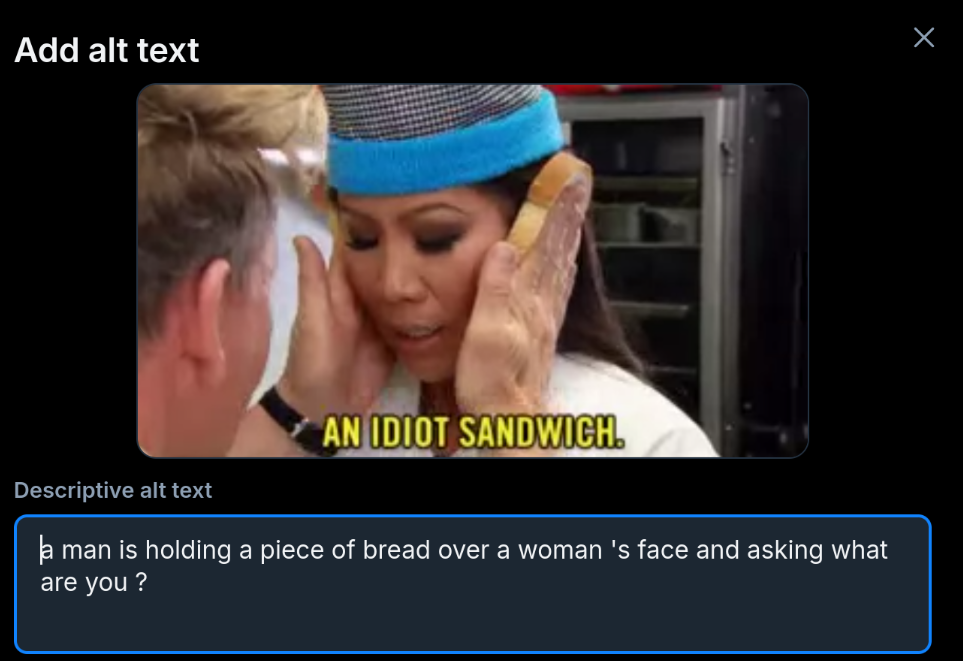
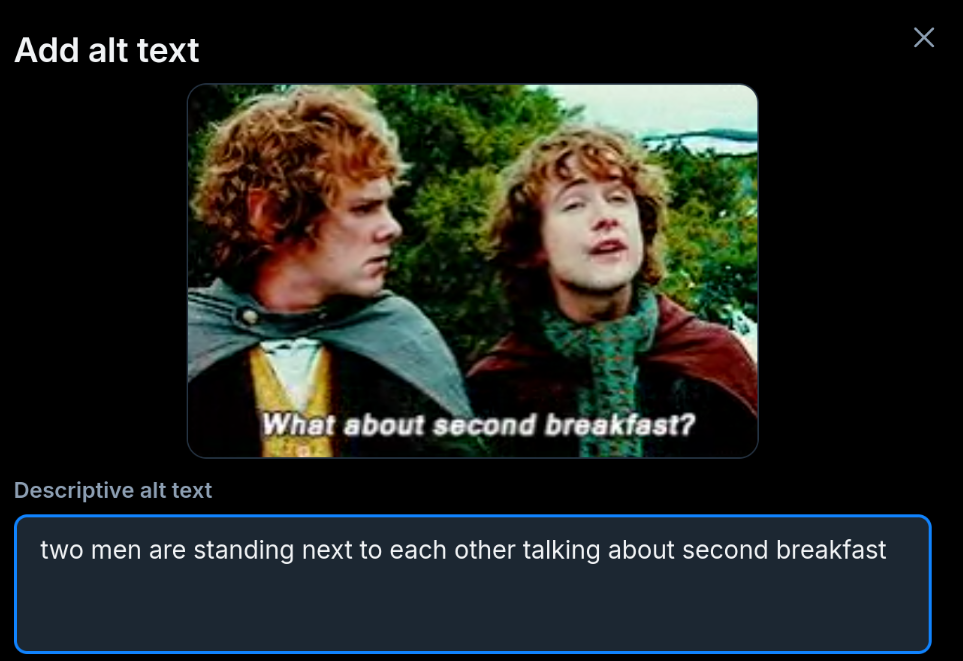
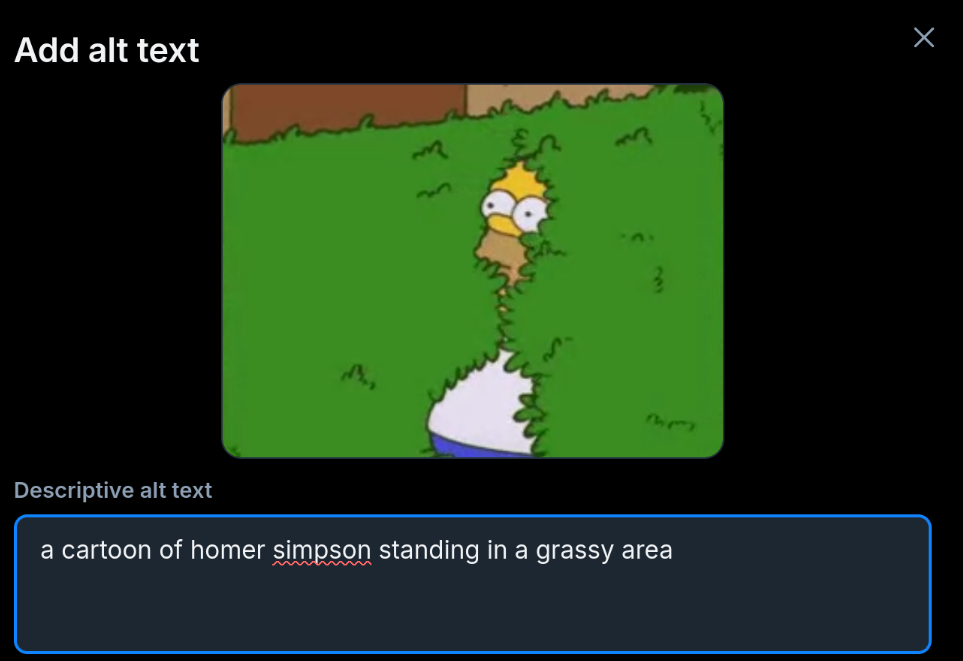
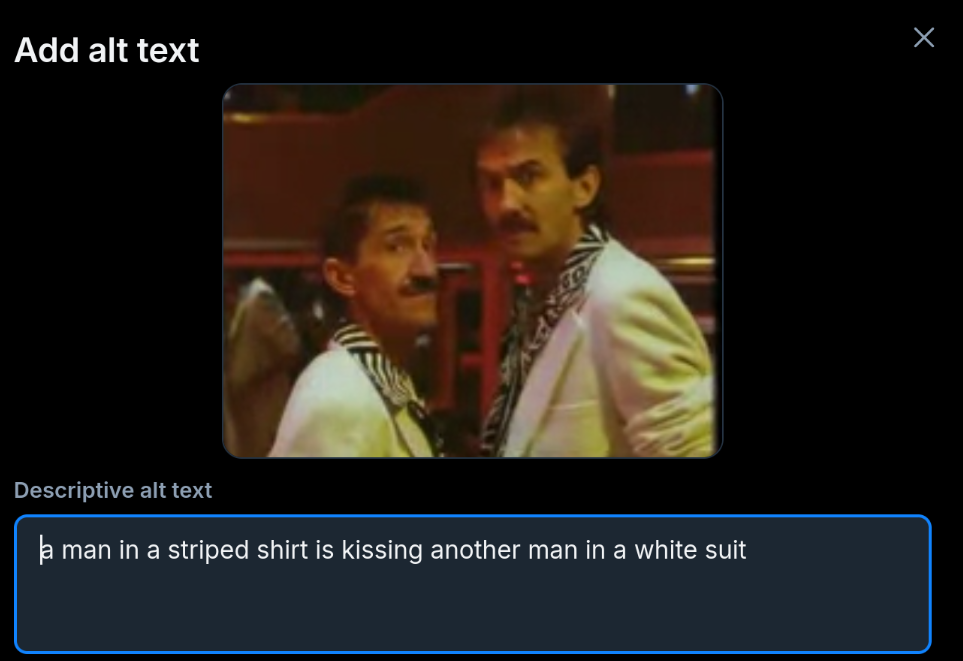
OK, so sometimes the captioner makes a mistake and thinks the Chuckle Brothers are kissing (WTF?!) perhaps we can excuse that as being an obscure image. But the "idiot sandwich" one is inexcusable. It's a popular meme with a specific meaning.
Which leaves me with a few questions for you:
- If you saw that the image you were sharing had crap alt text - would you bother editing it?
- Is bad alt text worse than no alt text?
- Can the same image have multiple meanings?
- Have you spent any time browsing the web with images turned off? Did you enjoy it?


6 thoughts on “The Idiot Sandwich - On Embedding Alt Text”
@Edent I think the alt text needs to reflect the context of the image.
When you chose to include the image, what information were you intending it to convey? That's the information to make available to non-/less-sighted folks via alt text.
A low-res JPEG of a funny meme may want very different alt text depending on whether it is used to add some humour or to illustrate image compression artifacts.
| Reply to original comment on social.afront.org
The same image can definitely have multiple meanings in different contexts, so as such I think it's bad for accessibility to embed alt text in an image. Alt text shouldn't describe what the image is; it should convey equivalent information to the image — that is, what a sighted person would get from seeing the image.
That may require describing the image in detail. Or it may be that most people would just glance at it or take note of one key part of it, in which case that's what needs describing. In the case of a meme, somebody's reaction is often “It's the Homer-hedge meme again” or, for other meme's “It's the [whatever] meme again except with the text of [new text]”. That's awkward, because the first time somebody sees a meme, they don't know it's a meme and might look at it in more detail, but how to provide the equivalent experience in alt text without forcing extraneous detail on people on each of the several hundred subsequent occasions they have that meme inflicted on them.
There's also an issue of what outside information to include in the description. The picture shows a bald yellow cartoon man with a big belly; sighted users don't get told that it's Homer Simpson (they either know that from existing culture, or experience the meme without discovering who it is), so should alt text provide that information?
I recently encountered somebody mentioning “the Drake meme”, along with a variant of a meme I'd seen many times before of somebody on a yellow background in one of those coats that look like hot-water-boiling cladding first looking away and putting their hand up to reject something, and second looking content and pointing a finger of approval at something else. I had no idea the person in that meme was Drake. Indeed, I had no idea it was somebody famous rather than a random member of the public who happened to have become meme-famous. If the alt text for that meme names Drake, it isn't equivalent for somebody like me; but if it doesn't name Drake, it's missing out information that many sighted users would get, and also makes its description longer.
This stuff is hard!
I did some research on maximum length of alt text (there are some myths around that), and also why you shouldn't use alt text for complex images (loosely defined as where the image is the main content), which might be of interest: https://www.lazaruscorporation.co.uk/blogs/artists-notebook/posts/complex-images (spoiler: there are better ways than alt text to provide a textual equivalent to an image for complex images, as defined by W3C WAI)
@Edent
It's an interesting subject but I think the selected examples reflect bad, probably AI-generated alt text; not including the visual text is a big error. In almost no context would that alt text be appropriate.
No social media client should automatically use embedded alt text but presenting it as a draft to the message author could be very handy, especially for popular meme images. "Homer Simpson receding into a bush" (maybe add "meme" to the end) would be sufficient alt text in most cases and a good start for others.
Such images are like that language made of idioms from Star Trek (a comparison made in the Wikipedia article about it), Homer (Simpson) is our Shaka, when the walls fell. Not everyone will understand the image's meaning visually or the alt text written in this way but IYKYK.
https://en.wikipedia.org/wiki/Darmok
Darmok - Wikipedia
| Reply to original comment on c.im
As someone with a disability requiring accommodation I’m used to accessibility being a joke… but it’s bizarre we have an opportunity to correct alt text from first principles across thousands of individual uses of these images and… just don’t.
| Reply to original comment on bsky.app
The first of these two questions has a different meaning on websites and blogs than it has in social media, e.g. the Fediverse. (If you're on Mastodon, or if what you post into the Fediverse may end up on Mastodon, accurate and sufficiently detailed alt-text is pretty much absolutely mandatory. You will be blocked a whole lot for not providing it.)
On a website or a blog, your alt-text is for your target audience. And you can steer your target audience using SEO. You can make sure that only certain people find your content.
In the Fediverse, you can't do that. Your alt-text has to cater to the random user who stumbles upon your post on some federated timeline just the same as to your followers. And to those who follow those who like one of your posts so much that they decide to boost it to all their followers.
Your audience is potentially literally the entire Fediverse. In fact, chances are that your audience is potentially everyone with an Internet connection. Your alt-text has to be for all of them all the same.
This means that you'll have to share more information in the Fediverse than on a website or a blog.
For example, if you have a website or a blog about a very obscure kind of 3-D virtual worlds, your can use SEO and grass-roots advertisement to make sure that only those discover your website or your blog who actually know these virtual worlds. They won't need any detailed descriptions, and they won't need any explanations either. Everyone else will ideally never know about your website or blog.
If you post about these worlds in the Fediverse, it's vastly different. Regardless of your target audience, your actual audience will be over 99% people who have never even heard of these worlds before, and who know exactly nothing about them. But still, they may be super curious about them because, up until they discovered your post, they thought that 3-D virtual worlds were dead, and they were super disappointed about that.
And no matter how much of a mainly visual medium 3-D virtual worlds are, you can't rule out that someone who is blind or visually impaired is interested in them.
Your audience may have many more blind or visually-impaired users. And your audience will almost entirely be completely clueless about what you're posting about. The blind or visually-impaired users won't have any idea what anything in your images looks like, so you can't simply assume that everyone does or that your audience does.
You will have to describe more in alt-text in the Fediverse than on a website or a blog. And you will have to explain more in your Fediverse posts than on your website or in your blog posts.
| Reply to original comment on hub.netzgemeinde.eu
More comments on Mastodon.