
Think global; act local. That's the mantra, right? I can't stop coal plants belching out suffocating pollutants, but can I ensure my website is as environmentally friendly as possible?
There are several services which claim to be able to detect just how lean, green, and clean your website is. But, in my opinion, they're all a bit inadequate.
WebsiteCarbon
The WebsiteCarbon.com service gives me this very pleasing report
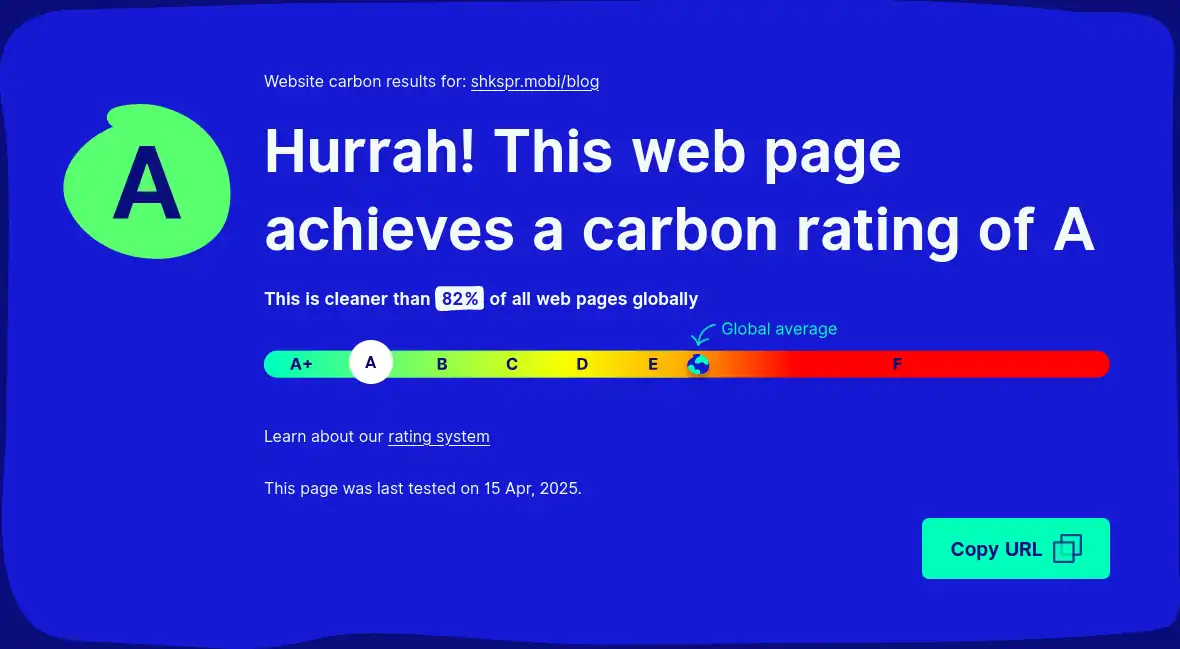
But what does that actually mean? There's an almost content-free description of their rating system. It boils down to how large your web pages are and whether your data centre runs on green energy.
I specifically chose Krystal as my host because of their green energy credentials. So it got that right.
WebsiteCarbon seems to just be an advertising pitch for their paid-for auditing services:
You can get a comprehensive view of a website’s emissions and potential improvements by carrying out a Website Carbon Audit.
Let's try another service.
EcoGrader
EcoGrader gives me a lower score but provides a lot more detail about why.
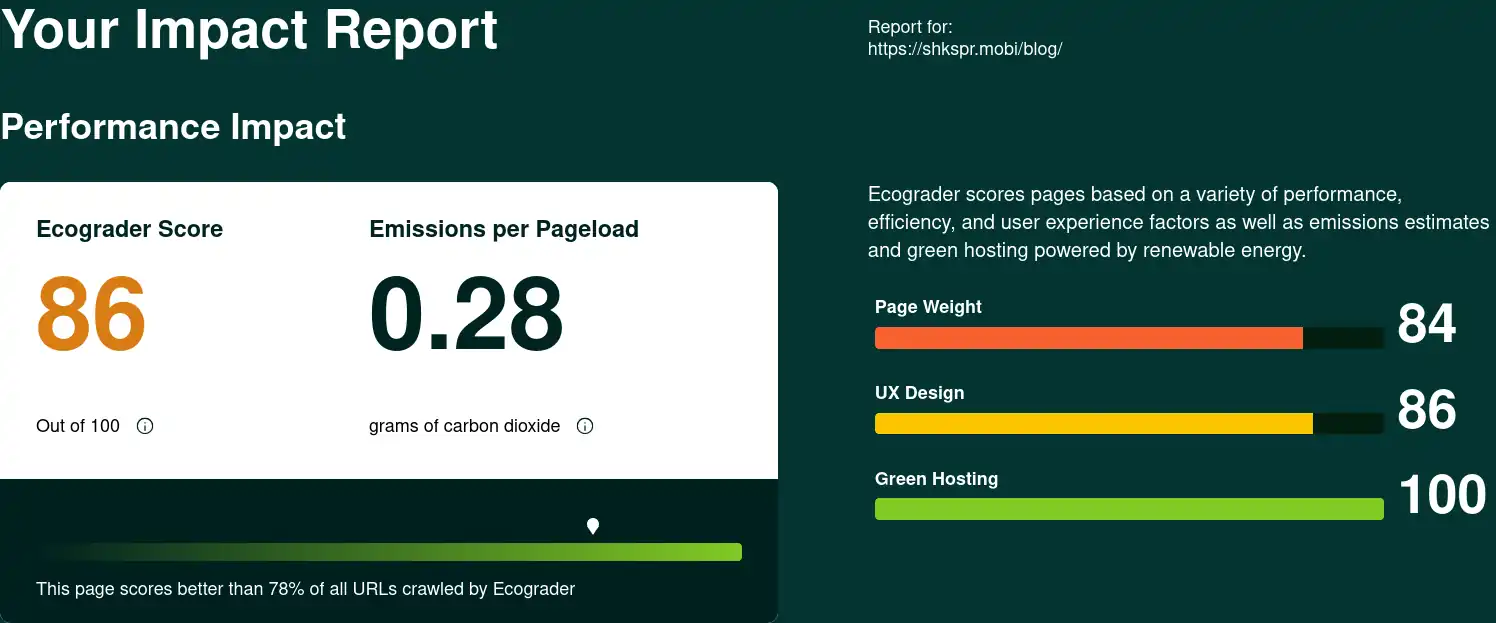
They also give tips on how I can improve things.
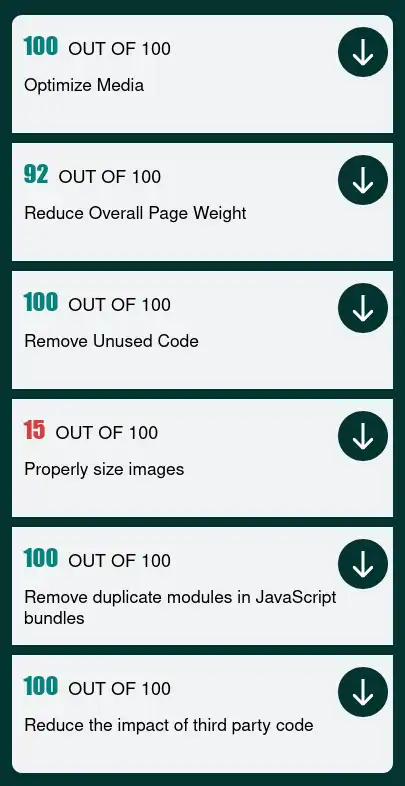
Do you notice anything about those tips? They're basically the same as Core Web Vitals! A set of useful, if generic, tips to optimise your website.
Others
There are several other services which claim to measure your site's eco-credentials. But, as far as I can tell, they're all doing the same thing; reskinning Core Web Vitals or similar products.
Some, like, Blacklight are promoted on the claim that excessive tracking scripts are an environmental disaster. In the end, the message is the same - clean up your website to make it faster more efficient.
What Does This Mean?
The energy efficiency of modern codecs is often asymmetric. It might be energy intensive to encode a movie - but that's paid back a thousand-fold by having to store and stream less data and by the efficiency of the decode process at the user's end.
If you operating at planetary scale then, yes, a small saving affecting a billion users will have a huge impact. If you're optimising a single hero image on your recipe blog, probably not so much.
Much like the discredited idea that by switching off your "standby" devices you can save £££, most of these website changes are marginal at best.
Yes, we should strive for svelte and performant websites - as much for usability as for environmentalism. It makes ecological sense to choose a hosting provider who is at least somewhat responsible in their energy usage - as much for cost as for anything else.
If these websites help convince your boss that you can remove horrific amounts of JS, upgrade images to WebP, and set sensible caching policies - great! Sell them the shiny accreditation badge while you go about making the site better.
Finally, a word of caution to anyone implicitly trusting these services - there's no way to know what's going on in the background of a website. An ultra efficient looking website served from a green data-centre, might be spinning up a dozen LLMs just to churn out the page content. A slow website might be solar powered. All those ultra-compressed images might be adverts for fossil fuels.
And every time you leave a comment on my blog, I shoot a panda.


5 thoughts on “Can you meaningfully measure how environmentally friendly a website is?”
Mike
Is it always the same Panda? What are you shooting them with?
This reminds me of a time about twenty years ago when there was a website which claimed to be a more environmentally friendly way to use Google. It had a search field which submitted a search to Google and the more environmentally friendly was claimed by way of the black background meant your monitor used less electricity because the electron gun didn't have to fire to make part of the screen black, because that's the screen's at rest state, whereas it had to fire a lot of make most of the screen white. The person who showed me it and told me what a good idea it was had an LCD monitor.
@Edent I worked on this project few month ago https://github.com/Conserto/GreenTrackR
It's not technically oriented so there is no advice to mitigate issues but it take into account data suck as the server location from https://app.electricitymaps.com/map/72h/hourly and others stuff.
Sadly I don't have time to work on it anymore to add firefox support, CLI integration, …
| Reply to original comment on mastodon.social
I hope it was a stuffed Panda
| Reply to original comment on bsky.app
@Edent aha, thanks for this analysis, i think you're bang on both on the seductiveness of quite marginal changes, and the lack of transparency around what's actually being claimed with these ratings! I was wondering, have you come across our work at the Green Web Foundation on https://carbontxt.org/? It's an attempt to standardise a means of communicating carbon reduction commitments and sustainability data which we hope will enable greater transparency about these claims.
| Reply to original comment on assemblag.es
@Edent I should also point out that our green web checker at thegreenwebfoundation.org/ is backed by verified (and independently verifiable!) data about hosting provider emissions, and we also have a hosting directory for those who are interested in finding and switching to sustainable infrastructure 🙂
| Reply to original comment on assemblag.es
More comments on Mastodon.