Category: qrpedia

The Engagement Economy

I was recently interviewed in The Guardian talking about the use of mobile phone in cultural institutions - museums, libraries, galleries, etc.

Terence Eden QRpedia Guardian Interview

I was talking about the QRpedia project I co-founded. During the course of the interview, a phrase fluttered into my head - "The Engagement Economy."

It wasn't a phrase I'd heard before - although Jane McGonigal wrote an excellent paper in 2008 with the same name. McGonigal's paper talks about getting people to work on a project. My idea of the Engagement Economy is around how to keep someone's attention in a world full of distractions.

Let's take a typical museum visitor - Alice. When she decides to walk in to a museum she experiences a range of possible distractions.

Her friends may want to chat, there's a movie playing down the road that she wants to see, Twitter keeps buzzing in her pocket, she wants to find out more about the exhibit she's looking at, noisy school-children are annoying her, there's a new podcast she wants to listen to, the list goes on.

Each exhibit in every room, throughout the museum has to compete for Alice's engagement. She may be standing in front of the Hunterian's collection of pickled penises yet her eyes are on Facebook, her ears are listening to the Pod Delusion, and her mind is in a state of Continuous Partial Attention.

How do we snap Alice back to make the most out of her museum visit? We could use the ideas of the Attention Economy - but this often means crudely interrupting Alice and forcing her down a path she wasn't willing to travel.

The "Engagement Economy" suggests that we place ourselves in the channels that Alice is already using.

Let me take four very good examples.

Social Networking

As well as making sure you're reading the tips and notes left by your visitors on FourSquare and FaceBook, you also need to respond to people talking to you on Twitter. Be proactive - catch them while they visit, engage with them on their platform of choice.

Dublin Zoo do this incredibly well:


Looking forward to going to @ tomoro. First time in it in about 10 years :-)
@shivyg5
siobhan gearty


@ Hope you are enjoying your day here!
@DublinZoo
Dublin Zoo

Video

Alice walks over to see the elephants in Dublin Zoo. Sadly, they're all asleep - which makes for a slightly dull few minutes. Engagement lost. Silly elephants - letting down a visitor like that.

Luckily, Dublin Zoo has uploaded some video of the elephants onto YouTube:

From the looks of that, it was probably shot with an employee's phone - or a cheap digital camera - then uploaded to YouTube. Almost zero cost to the zoo - but a great way to engage with visitors who may otherwise be left frustrated.

It's also "blipvert" length. Long enough to be interesting, but short enough to download on a phone and watch quickly.

Audio

Produce your own audio - let visitors download it. Everyone visiting your site will have a mobile phone. You don't need to rent out audio guides - give people the MP3 to download.

I saw this done last year - the Tracey Emin retrospective gave away an MP3 audio guide. Those who want to listen can do so using their own equipment (which will automatically pause if they receive a phone call, etc).

Emin MP3

Wikipedia

What can Alice do if she wants to see more information on an exhibit? Most cultural institutions have a few lines on a card and, if you're lucky, a curator who can give more detail.

Alice is just going to go directly to Wikipedia on her phone. That's where QRpedia comes in. QRpedia puts QR codes on exhibits which then link to mobile Wikipedia.

The really clever part is that QRpedia codes do language detection, so Alice sees the English Wikipedia, no matter which country she is in. Similarly, Jacques sees the French Wikipedia even if he's at Dublin Zoo.
TCMI Carousel QRpedia Label
Your staff should be editing Wikipedia, improving the articles, uploading photos.


Wikipedia run an outreach programme for Gallaries, Libraies, Archives, and Museums (and pretty much anyone else!) which can help you make the most of Wikipedia.

It's the Engagement Economy, Stupid

Participating in the Engagement Economy doesn't mean disrupting people, it doesn't mean forcing them down a specific path, and it doesn't mean that you have to interact every visitor on every channel.

The Engagement Economy means you have to know what is diverting the engagement of the majority of your visitors. Find a subtle way to insert yourself in that channel, and produce content which will hold their engagement.

Museums Showoff

This was the sign that greeted me as I made my way into The Camden Head for the first Museums Showoff...
Pub Sign reading "Terence Eden and Guests"

Now, I've no idea why I was the headliner - but I certainly wasn't going to complain!

Museums Showoff is a spin-off from the popular Science Showoff. The idea is that ten speakers come along and show off. They chat about what they're doing, things they've made, stuff they've built, or anything that gets their juices flowing.

With the permission of the participants, I recorded the event. Here are the videos:

Subhadra Das - UCL Pathology

A touching and hilarious talk about all the grim and icky stuff found in formaldehyde jars.

Terence Eden - QRpedia

This suspiciously good looking chap chatted about QRpedia

Brian Macken - Dublin's Dead Zoo

A high speed history of Dubin's Natural History Museum. I really regret not visiting it when I was last in Ireland.

Rosie Clarke - Museums at Night

I love the idea of Museums at Nights - this was a great explanation of the effort it takes to put on the event each year.

Ayla Lepine - Architecture

How do you get kinds interested in architectural drawing? Alya Lepine explains all.

Steve Lloyd - Physical and Digital

A fascinating talk about digital signage in the modern museum.

Gordon Cummings - Fry Gallery

Did you know about the Fry Gallery? Gordon gave an entertaining talk about the gallery and the stories behind it.

Catherine Walker - Handling Objects

Who wants to squeeze a brain? Or see how a shrunken head is made?

Overall, a fascinating event with a great turn out, and a lot of money was raised for Arts Emergency.

A Year of QRpedia!

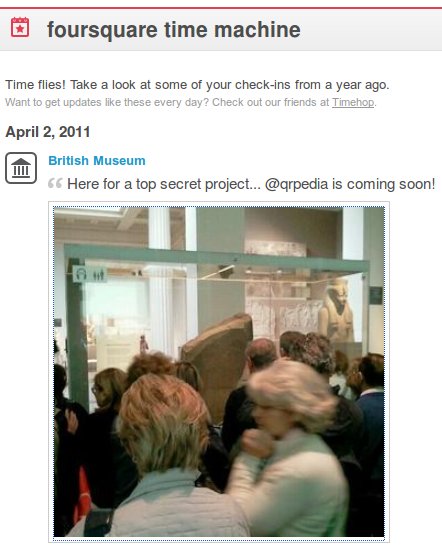
An email from FourSquare this morning reminded me what I was doing a year ago today.

QRpedia Birthday

I spent the morning at The British Museum doing the first public experiments with QRpedia.

This is a video of the historic occaision.

So, here's a quick run down of what this volunteer-lead project has acheived in a single year, in no particular order:

  • Derby Museum installation
  • UK National Archives installation
  • The Children's Museum of Indianapolis installation
  • Sofia Zoo installation
  • Juan Miro installation
  • Monmouthpedia - covering Monmouth with hundreds of QRpedia codes
  • Over 42,000 scans of the codes
  • Named one of the top four most innovative mobile companies in the UK
  • Become part of the "Occupy" movement
  • Received scans from over 100 different countries

Wow! What a ride! From a few comments on Wikipedia and blogs, to project launch, to global domination :-) QRpedia really emphasises what a team of commited volunteers can do if they work together.

I'll be demoing QRpedia at Museums Showoff on April 25th in Camden.

If you work with a museum, gallery, archive, library, zoo, garden - or any other cultural institution - and want to use QRpedia, visit the website or drop us an email to get started.

QRpedia - We Made The Shortlist for Most Innovative Mobile Company!

We're incredibly excited to announce that QRpedia has made the shortlist for the Smart UK Project!

qrpedia shortlist

We are searching for the UK's Most Innovative Mobile Companies. Our aim is to celebrate UK innovation and showcase the best examples of UK mobile innovation.

We'll be presenting at the competition oin January - if we make the final six, we'll be off to Mobile World Congress.

Look out world! Here comes QRpedia!

Occupy QR Codes

I was tweeted an interesting link the other day - We Don't Make Demands. They have a set of posters for the "Occupy Movement" which incorporate QRpedia codes.

These posters were designed by participants at the Occupy Wall Street protest in New York City. They are in the public domain. You are welcome to print them out and post them in your own location.

Occupy QR Poster
See all the posters.

I love this use of QRpedia - but I have two minor suggestions.
QR codes work best with some whitespace around them, so:

  1. Move the QR code away from the margin - so it won't get covered by tape etc.
  2. The call to action - "Learn More At Wikipedia" - should be slightly further away from the main body of the code.

Other than that - very impressive.

OccupyLSX

I took a walk through the OccupyLSX encampment at St Pauls. I have to say, the QR codes on display weren't as impressive as the above posters.


More Resources

There are a range of Occupy QR codes out there. Some work really well, some don't. Take a look at:
Occupy Syracuse QR.
Occupy Austin QR.
Occupy Las Vegas QR.
Occupy Davis QR.
And finally, Occupy Legoland.